


Published on ACCOUNTS (30 September 2025)
Author(s): Danyang Ji, Kun Zhang, Maryana Yarshova, Chun Kit Kwok
Abstract
Aptamers are single-stranded DNA or RNA oligonucleotides that bind specifically and strongly to their target molecules. However, the inherent instability of natural DNA and RNA aptamers in biological environments limits their applications. To overcome this limitation, we focused on the development and application of L-RNA aptamers composed of unnatural L-RNA nucleotides. The mirror stereochemistry of L-RNA confers enhanced stability against nuclease degradation, making it an ideal candidate for molecular targeting and biological applications. In addition, L-RNA’s inability to hybridize with D-DNA/RNA through Watson–Crick base pairing enables the selection of aptamers based on structure recognition. Our group focuses on targeting functional G-quadruplex (G4) structures that play critical roles in various cellular processes, including DNA replication, transcription, and translation, and are implicated in diseases such as cancers, neurological disorders, and viral pathogenesis.
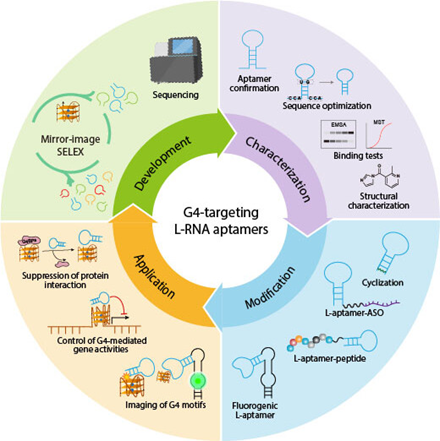
This Account highlights our group’s recent efforts in developing novel and robust L-RNA aptamer selection platforms and tools for targeting functionally important G4 structures in different biological systems. Pioneering the L-RNA aptamer selection method for G4 structures, we have further established additional selection platforms enhancing SELEX (Systematic Evolution of Ligands by EXponential enrichment) efficiency, as well as binding affinity and specificity for G4 targets. Following lead aptamer identification and characterization using various biophysical and biochemical tools, our group has explored a number of innovative post-SELEX modification strategies to further improve the L-RNA aptamer’s functionality. Such include the development of circular L-RNA aptamers, L-RNA aptamer-antisense oligo (ASO) conjugates, L-RNA aptamer-fluorogenic RNA aptamer conjugates, and L-RNA aptamer-peptide conjugates for various in vitro, in-cell, and in vivo applications. From our studies, we have reported that these L-RNA aptamers can effectively regulate G4-mediated cellular processes by inhibiting G4-protein interactions and/or modulating transcription and translation and ultimately influencing gene expression and beyond.
Together, these works have advanced the accessibility, efficiency, and robustness of L-RNA aptamer technology, offering significant potential for the diagnosis and therapeutics of various diseases, particularly those related to G4 dysregulation. Our ongoing research seeks to further refine L-RNA aptamer selection, structure characterization, post-SELEX modification strategies, and their applications in biological and therapeutic contexts.
 |
 |
Read more: https://pubs.acs.org/doi/10.1021/acs.accounts.5c00468