


Published on Nature Materials (24 October 2025)
Author(s): Yanfu Ma, Shuhui Liu, Jianing Mao, Mingzi Sun, Ke Shi, Wenyi Li, Wantong Zhao, Jieqiong Shan, Yang Zhao, Zheng Jiang, Riguang Zhang, Rui Gao, Wei Liu, Bolong Huang, G. Q. Max Lu, Jian Liu & Limin Wu
Abstract
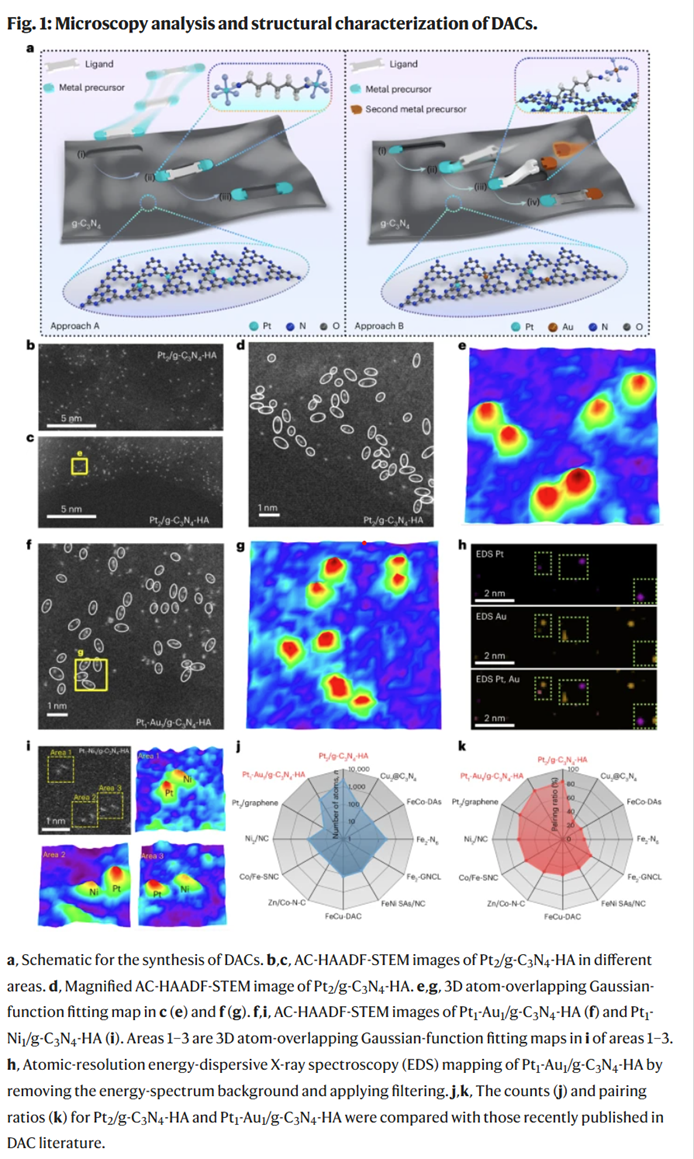
Dual-atom catalysts (DACs) exhibit high catalytic activity and metal utilization, alongside structural diversity with a wide range of catalytic site configurations. These features position DACs as promising candidates for energy conversion technologies. However, the precise control over atomic dispersion, pairing ratios and interatomic distances—which critically influence their multifunctional catalytic behavior—remains a formidable challenge. Here we developed a ligand-restricted strategy for the precise synthesis of highly paired DACs with tunable atomic distances. This was accomplished by coordinating diamine ligands with dual-metal precursors, restricting the pairing and relative positions of two metal atoms on two-dimensional graphitic carbon nitride. The atomic pairing ratio exceeded 82%, and the atomic pairing distance was controlled by the chain length of the diamine ligand. As a demonstration, the paired Pt1-Au1 DACs exhibited almost threefold enhancement in catalytic activity for nitrate reduction to ammonia compared with their unpaired counterparts. This work introduces an effective strategy for the atomic-scale fabrication of complex catalysts as well as provides valuable insights into nanoscale reaction mechanisms in heterogeneous catalysis.

Read more: https://www.nature.com/articles/s41563-025-02385-6