


Published on Nature Communications (22 March 2024)
Author(s): Haokun Li, Jiachen Yao, Gan Xu, Shek-Man Yiu, Chi-Kit Siu, Zhen Wang, Yung-Kang Peng, Yi Xie, Ying Wang & Zhenpin Lu
Abstract
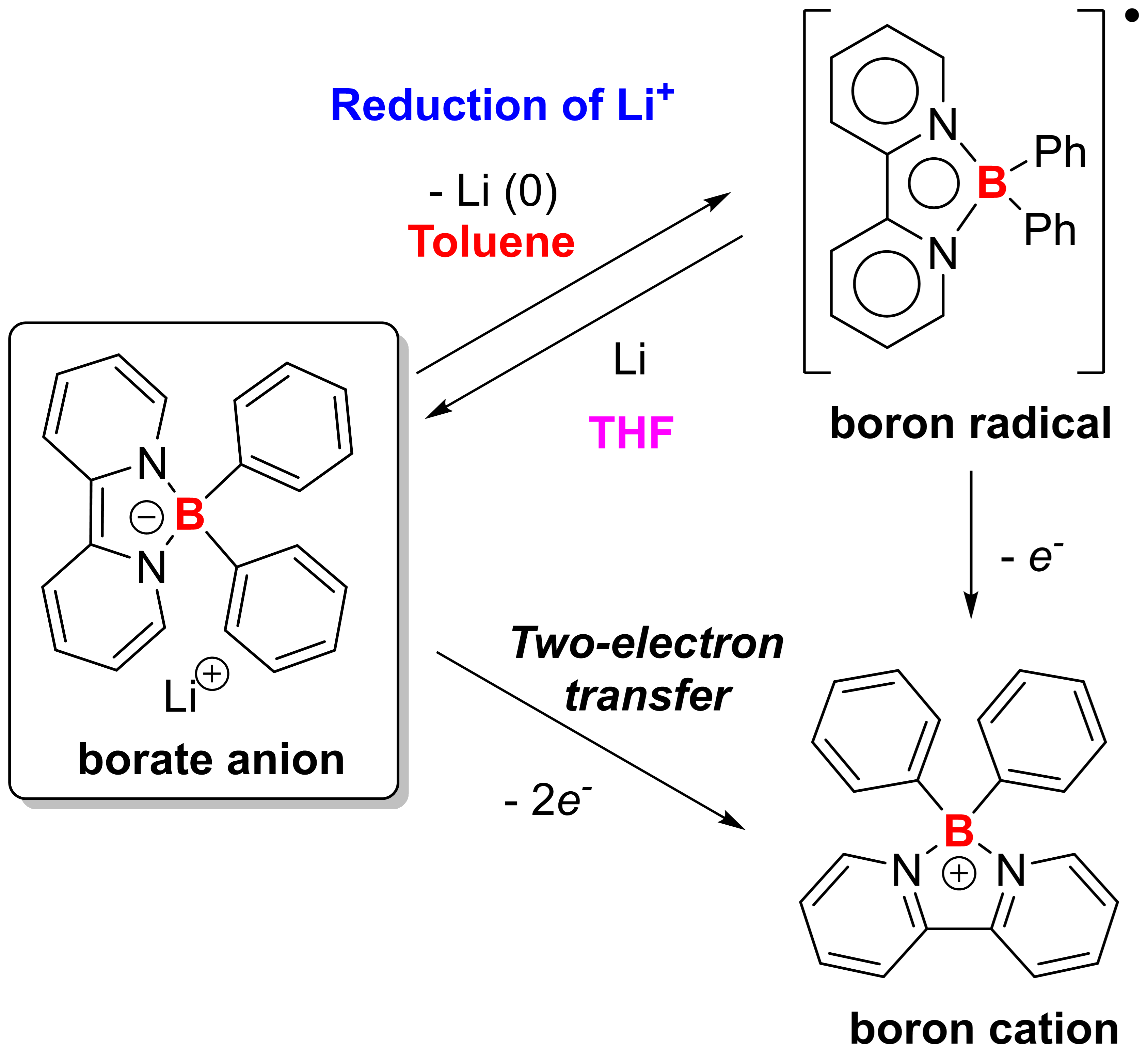
Group 1 elements exhibit the lowest electronegativity values in the Periodic Table. The chemical reduction of Group 1 metal cations M+ to M(0) is extremely challenging. Common tetraaryl borates demonstrate limited redox properties and are prone to decomposition upon oxidation. In this study, by employing simple yet versatile bipyridines as ligands, we synthesized a series of redox-active borate anions characterized by NMR and X-ray single-crystal diffraction. Notably, the borate anion can realize the reduction of Li+, generating elemental lithium metal and boron radical, thereby demonstrating its potent reducing ability. Furthermore, it can serve as a powerful two-electron-reducing reagent and be readily applied in various reductive homo-coupling reactions and Birch reduction of acridine. Additionally, this borate anion demonstrates its catalytic ability in the selective two-electron reduction of CO2 into CO.

Read more: https://www.nature.com/articles/s41467-024-46948-8