Global application of artificial mussels
Involved Members: Prof. Rudolf Shiu Sun WU, Prof. Kenneth Mei Yee LEUNG, Dr. Jill Man Ying CHIU
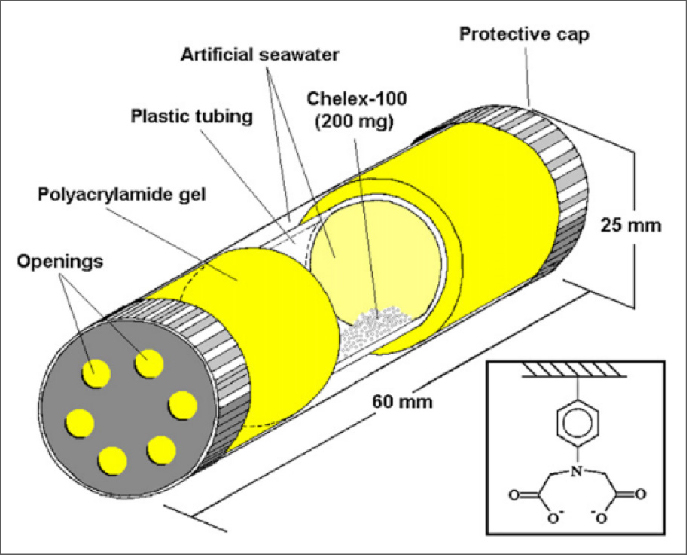
To overcome the longstanding problem and limitation of metal monitoring in the marine environment, a novel chemical sampling device, artificial mussel (AM), has been developed by Wu et al. (2007) for monitoring metals in marine environments. The device consists of a non-permeable Perspex tubing with the polymer-ligand Chelex100 resin suspended in artificial seawater inside and enclosed with semi-permeable polyacrylamide (SPP) gel at both ends. The SPP gel allows slow passage of metal ions through the pores before chelating with the resin.
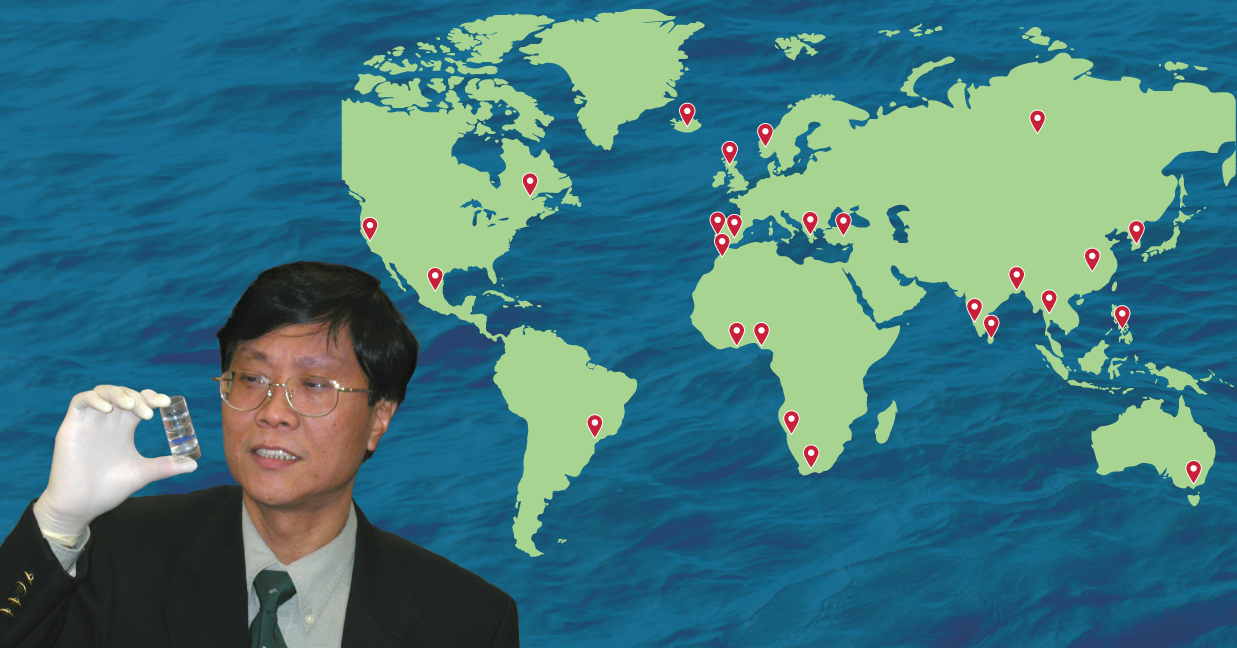
Field tests with AMs in coastal environments of Scotland, Iceland, South Africa, and Portugal have illustrated that AMs and different species of native mussels exhibit similar accumulation patterns for common toxic metals (Leung et al., 2008; Degger et al., 2011; Gonzalez-Rey et al., 2011; Claassens et al., 2016), but a significant difference was found for Zn (Degger et al., 2011; Gonzalez-Rey et al., 2011), and Pb (Leung et al., 2008; Gonzalez-Rey et al., 2011). Kibria et al. (2012) used AMs to identify “hot spots” of trace metal in freshwater catchments in Victoria, Australia, and estimate the potential environmental and public health risks.
Ruiz-Fernández et al (2018) found that Hg and U can be accumulated in AMs but not in native oyster and mussel species in Mexico waters, suggesting that AM may be more robust than biomonitors in metal monitoring. Based on a comprehensive study in five cities spanning from temperate to tropical environment along the China coastline, Degger et al. (2016) concluded that AMs can provide a more reliable time integrated estimate on metal concentration over large geographic areas with different hydrographic conditions, and overcomes the longstanding problems of monitoring metals in water, sediment and bioindicators. Likewise, Shen et al., (2020) compared accumulations of eight trace metals: Cd, Pb, Cu, Zn, Cr, Se, Hg, and As, between AMs and live mussels (LMs) in Australian coastal waters, and concluded that AMs are excellent replacement of LMs for the biomonitoring of multiple kinds of trace metals.
For the first time, the AMs allow us to make global comparison of metal concentrations in the marine environment.
The global application of AM in metal monitoring have been published in leading international journals including Environment International, Environmental Pollution, Chemosphere, Ecological Indicators, Journal of Evironmental Management, Marine Pollution Bulletin, Marine and Freshwater Research.
References:
1. Claassens, L., Dahms, S., van Vuren, J.H.J. and Greenfield, R. (2016). Artificial mussels as indicators of metal pollution in freshwater systems: A field evaluation in the Koekemoer Spruit, South Africa. Ecological Indicators, 60, 940-946.
2. Degger, N., Chiu, J.M.Y., Po, B.H.K., Tse, A.C.K., Zheng, G.J., Zhao, D.M., Xu, D., Cheng, Y.S., Wang, X.H., Liu, W.H., Lau, T.C. and Wu, R.S.S. (2016). Heavy metal contamination along the China coastline: A comprehensive study using Artificial Mussels and native mussels. Journal of Environmental Management, 180, 238-246.
3. Degger, N., Wepener, V., Richardson, B.J. and Wu, R.S.S. (2011). Application of artificial mussels (AMs) under South African marine conditions: A validation study. Marine Pollution Bulletin 63(5-12), 108-118.
4. Genc, T.O., Po, B.H.K., Yilmaz, F., Lau, T.C., Wu, R.S.S. and Chiu, J.M.Y. (2018). Differences in metal profiles revealed by native mussels and artificial mussels in Sarcay Stream, Turkey: implications for pollution monitoring. Marine and Freshwater Research, 69(9), 1372-1378.
5. Gonzalez-Rey, M., Lau, T.C., Gomes, T., Maria, V.L., Bebianno, M.J. and Wu, R.S.S. (2011). Comparison of metal accumulation between ‘Artificial Mussel’ and natural mussels (Mytilus galloprovincialis) in marine environments. Marine Pollution Bulletin, 63(5-12), 149-153.
6. Kibria, G., Lau, T.C. and Wu, R.S.S. (2012). Innovative ‘Artificial Mussels’ technology for assessing spatial and temporal distribution of metals in Goulburn-Murray catchments waterways, Victoria, Australia: Effects of climate variability (dry vs. wet years). Environment International, 50, 38-46.
7. Leung, K.M.Y., Furness, R.W., Svavarsson, J., Lau, T.C. and Wu, R.S.S. (2008). Field validation, in Scotland and Iceland, of the artificial mussel for monitoring trace metals in temperate seas. Marine Pollution Bulletin, 57(6-12), 790-800.
8. Ruiz-Fernandez, A.C., Wu, R.S.S., Lau, T.C., Perez-Bernal, L.H., Sanchez-Cabeza, J.A. and Chiu, J.M.Y. (2018). A comparative study on metal contamination in Estero de Urias lagoon, Gulf of California, using oysters, mussels and artificial mussels: Implications on pollution monitoring and public health risk. Environmental Pollution, 243, 197-205.
9. Shen, H., Kibria, G., Wu, R.S.S., Morrison, P. and Nugegoda, D. (2020). Spatial and temporal variations of trace metal body burdens of live mussels Mytilus galloprovincialis and field validation of the Artificial Mussels in Australian inshore marine environment. Chemosphere, 248, 126004.
10. Wu, R.S.S., Lau, T.C., Fung, W.K.M., Ko, P.H. and Leung, K.M.Y. (2007). An ‘artificial mussel’ for monitoring heavy metals in marine environments. Environmental Pollution, 145(1), 104-110.