Speakers & Abstracts
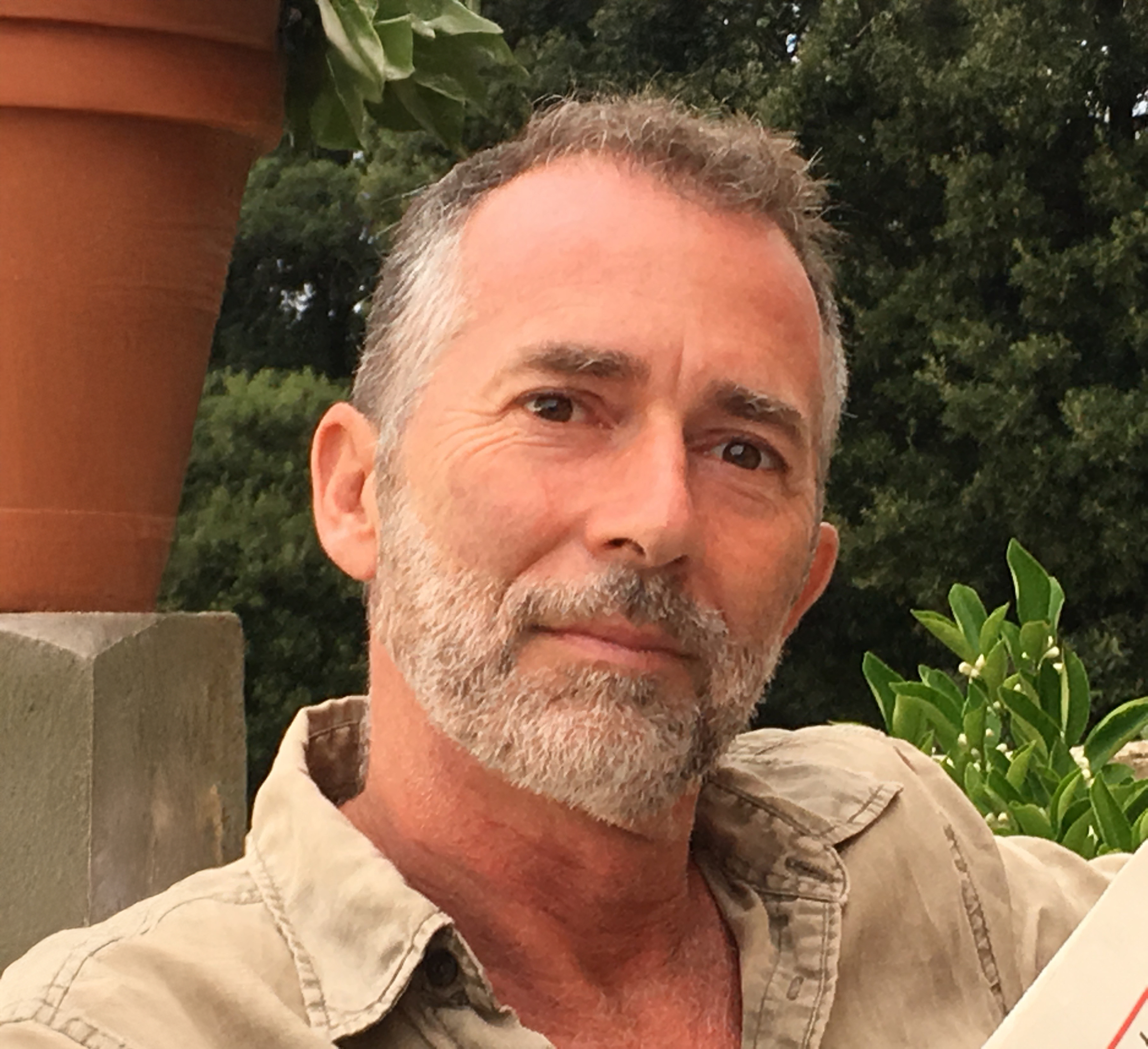
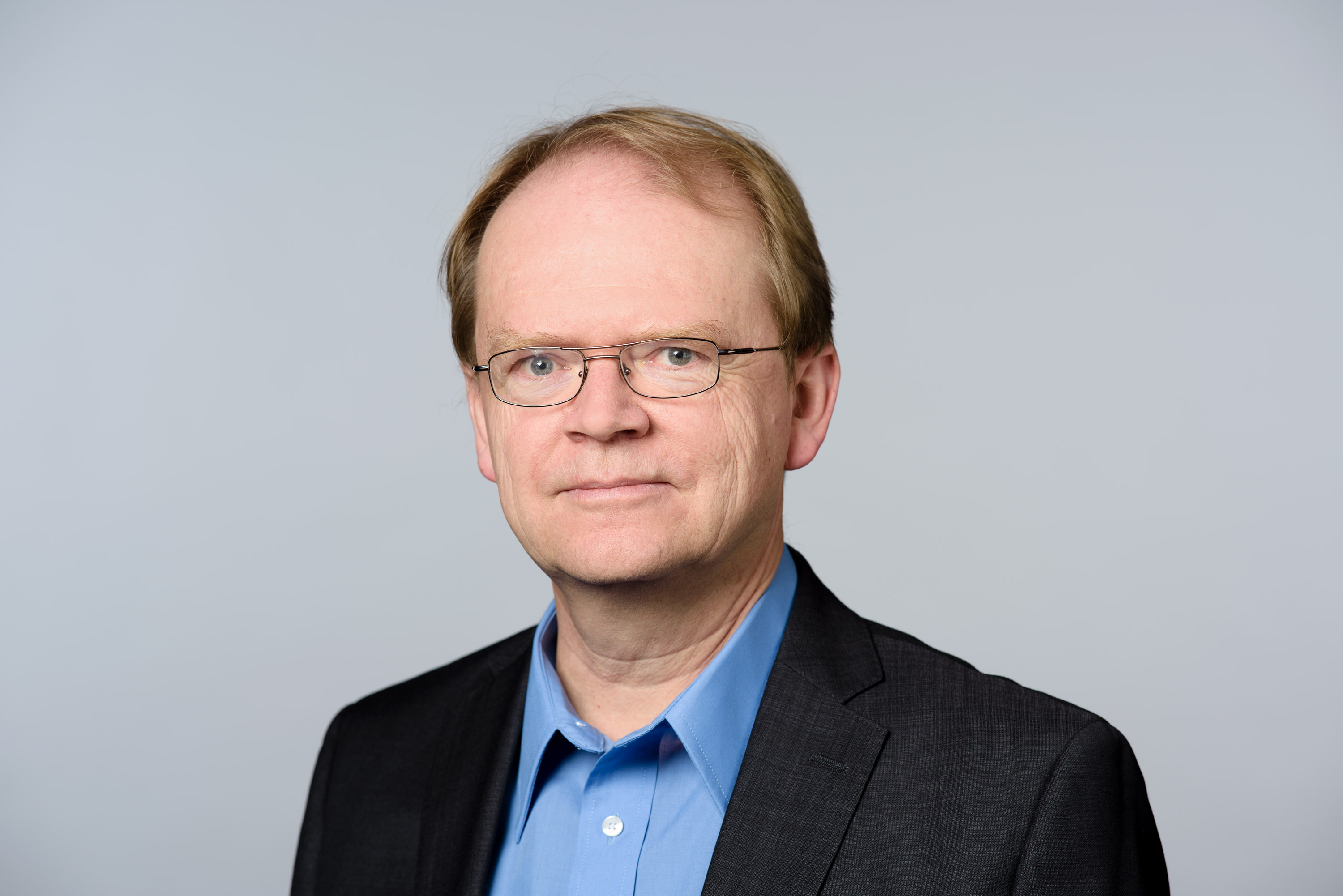
Prof Albert Cohen
Sorbonne University, France
[Invited Speaker]
Title: Optimal sampling
Abstract: Recovering an unknown function from point samples is an ubiquitous task in various applicative settings: non-parametric regression, machine learning, reduced modeling, response surfaces in computer or physical experiments, data assimilation and inverse problems. In this lecture we discuss the context where the user is allowed to select the measurement points (sometimes refered to as active learning). This allows one to define a notion of optimal sampling point distribution when the approximation is searched in a arbitrary but fixed linear space of finite dimension and computed by weigted-least squares. Here optimal means that the approximation is comparable to the best possible in this space, while the sampling budget only slightly exceeds the dimension. We present simple randomized strategies that provably generate optimal samples, and discuss several ongoing developments.
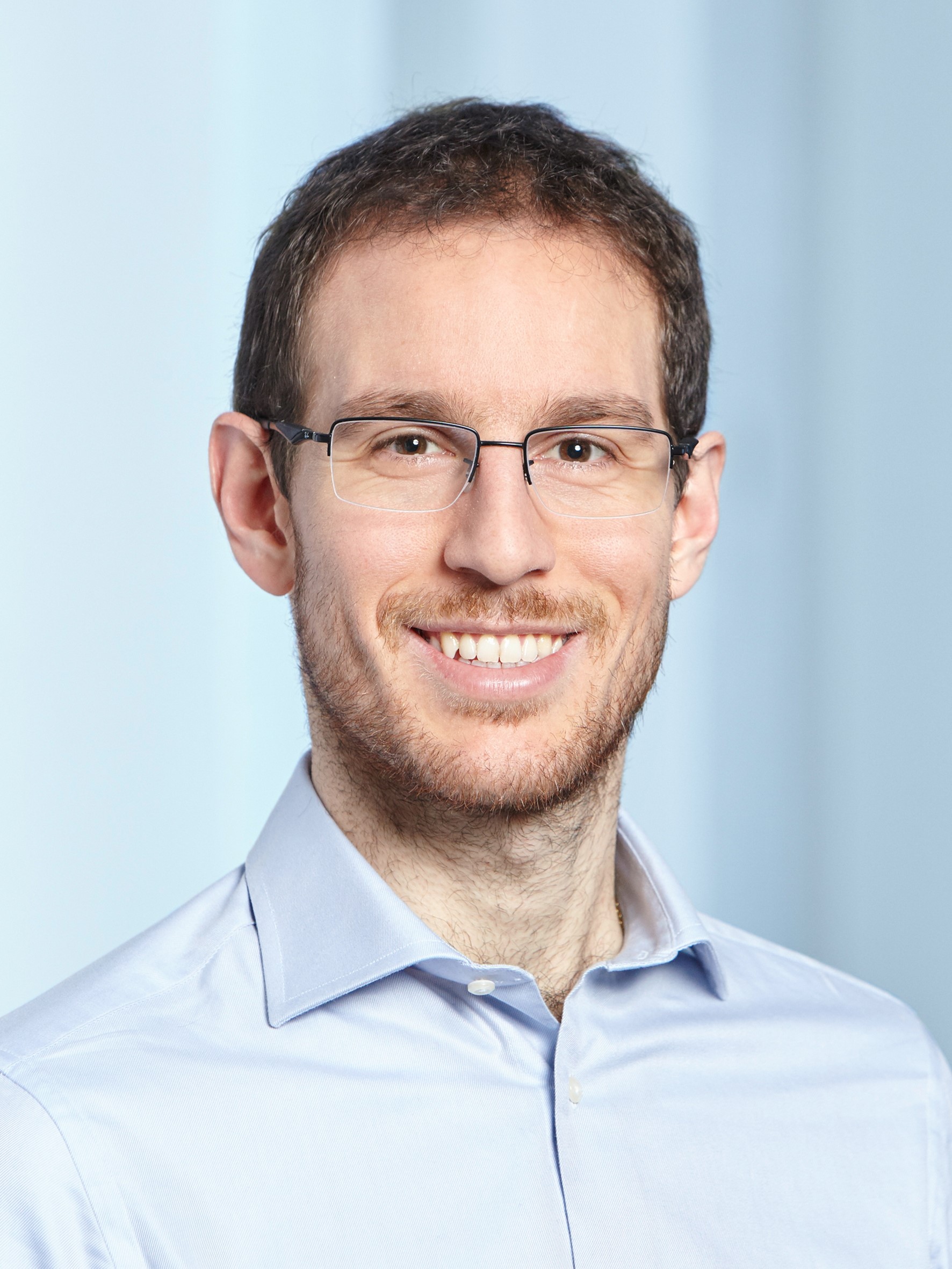
Albert Cohen is a professor at Laboratoire Jacques-Louis Lions Sorbonne University, Paris, France. After early works concerned with the development of the theory of wavelet bases in relation with algorithms used in signal and image processing, his research has been oriented towards various applicative directions, with as a common denominator its theoretical foundations in nonlinear approximation theory and harmonic analysis.
In particular, it has led to the development and analysis of adaptive and sparsity-based numerical methods in various application contexts such as data compression, statistical estimation and learning theory or the numerical treatment of partial differential equations. His more recent interest lies in problems that involve a very large number of variables, and whose efficient numerical treatment is therefore challenged by the curse of dimensionality, as well as in model reduction strategies for the purpose of forward simulation and inverse problems.
Albert Cohen's research has been supported by the Advanced ERC grant BREAD (Breaking the Curse of Dimensionality in Analysis and Simulation) awarded in 2014. He has been a junior and senior member of the Institut Universitaire de France, and he is a member of the European Academy of Sciences.
Title: Optimal sampling
Abstract: Recovering an unknown function from point samples is an ubiquitous task in various applicative settings: non-parametric regression, machine learning, reduced modeling, response surfaces in computer or physical experiments, data assimilation and inverse problems. In this lecture we discuss the context where the user is allowed to select the measurement points (sometimes refered to as active learning). This allows one to define a notion of optimal sampling point distribution when the approximation is searched in a arbitrary but fixed linear space of finite dimension and computed by weigted-least squares. Here optimal means that the approximation is comparable to the best possible in this space, while the sampling budget only slightly exceeds the dimension. We present simple randomized strategies that provably generate optimal samples, and discuss several ongoing developments.
Albert Cohen is a professor at Laboratoire Jacques-Louis Lions Sorbonne Universit , Paris, France. After early works concerned with the development of the theory of wavelet bases in relation with algorithms used in signal and image processing, his research has been oriented towards various applicative directions, with as a common denominator its theoretical foundations in nonlinear approximation theory and harmonic analysis.
In particular, it has led to the development and analysis of adaptive and sparsity-based numerical methods in various application contexts such as data compression, statistical estimation and learning theory or the numerical treatment of partial differential equations. His more recent interest lies in problems that involve a very large number of variables, and whose efficient numerical treatment is therefore challenged by the curse of dimensionality, as well as in model reduction strategies for the purpose of forward simulation and inverse problems.
Albert Cohen's research has been supported by the Advanced ERC grant BREAD (Breaking the Curse of Dimensionality in Analysis and Simulation) awarded in 2014. He has been a junior and senior member of the Institut Universitaire de France, and he is a member of the European Academy of Sciences.
Prof Alessio Figalli
ETH Zurich, Switzerland
[Invited Speaker]
Title: Optimal Transport: From A to B and Beyond
Abstract: Ever wonder what the most efficient way is to move something from here to there? That's precisely the question Gaspard Monge took on back in the 18th century. Fast forward to today, and the theory of Optimal Transport (OT) has evolved into a surprisingly versatile framework used in areas as diverse as economics, data science, and the natural sciences. In this talk, we'll take a friendly tour through the fundamentals of OT, showing how it elegantly tackles "moving" problems big and small. We'll also dive into a few fascinating applications, offering a glimpse of why OT has become such a central tool in modern mathematics and beyond.
Title: Free boundary regularity for the obstacle problem
Abstract: The classical obstacle problem consists of finding the equilibrium position of an elastic membrane whose boundary is held fixed and constrained to lie above a given obstacle. By classical results of Caffarelli, the free boundary is smooth outside a set of singular points. However, explicit examples show that the singular set could be, in general, as large as the regular set. This talk aims to introduce this beautiful problem and describe some classical and recent results on the regularity of the free boundary.
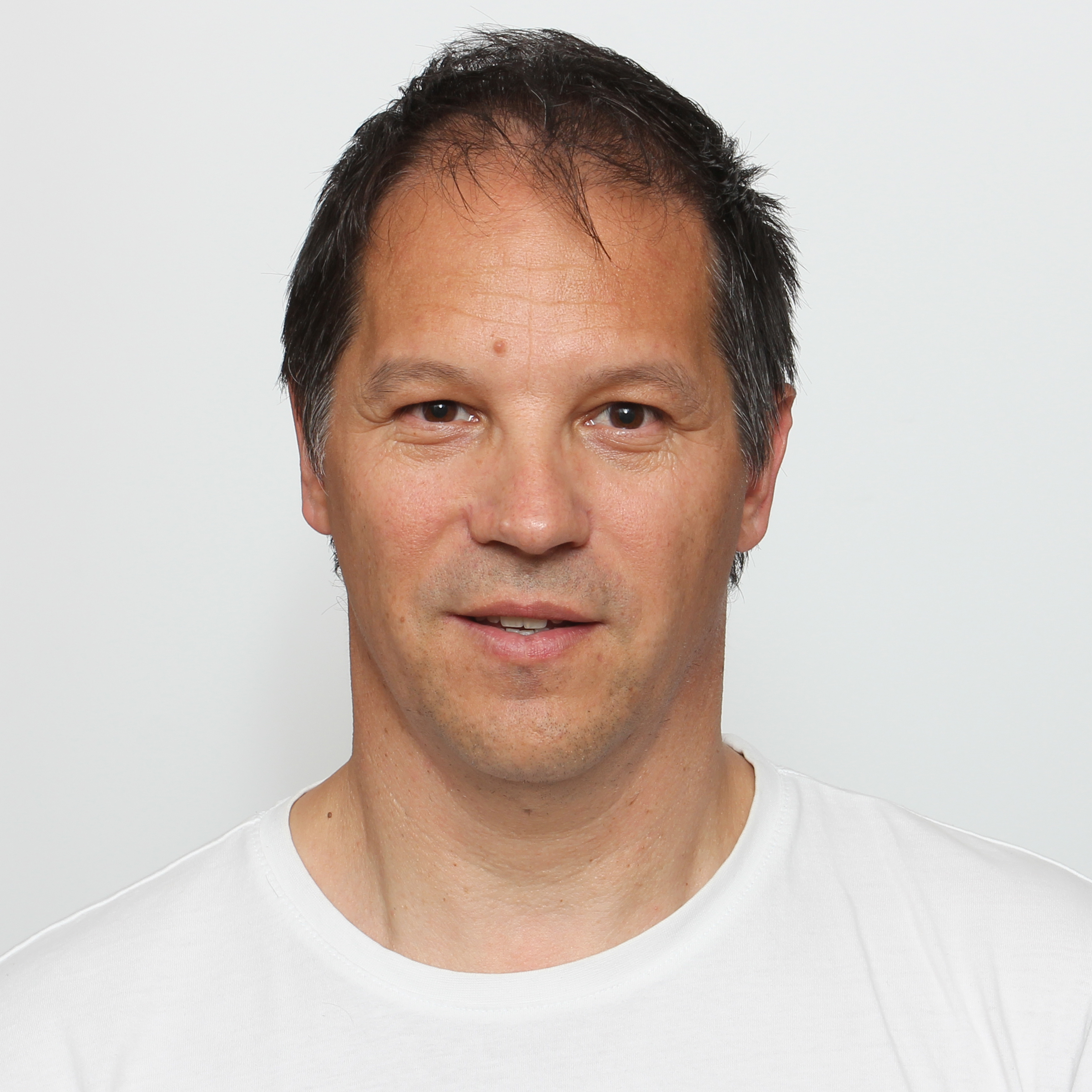
Alessio Figalli, born in Rome in 1984, is an Italian mathematician. After receiving his bachelor's and master's degrees in mathematics from the University of Pisa, he obtained a joint Ph.D. in mathematics between Pisa and Lyon. He held faculty positions in France and the United States before joining ETH Zurich in 2016 as a full professor. Since 2019, Figalli has been the director of the Institute for Mathematical Research at ETH Zurich.
Figalli has received numerous prestigious awards, most notably the 2018 Fields Medal "for contributions to the theory of optimal transport and its applications in partial differential equations, metric geometry, and probability." He has authored more than 150 international publications, serves as a scientific advisor and board member for several research institutes, and is actively involved in teaching and mentoring. Among his other honors, Figalli has been named a Knight of the Order of Merit of the Italian Republic, received several honorary doctorates, and even had the asteroid 438523 named after him.
HKIAS Distinguished Lecture Series
Title: Optimal Transport: From A to B and Beyond
Abstract: Ever wonder what the most efficient way is to move something from here to there? That's precisely the question Gaspard Monge took on back in the 18th century. Fast forward to today, and the theory of Optimal Transport (OT) has evolved into a surprisingly versatile framework used in areas as diverse as economics, data science, and the natural sciences. In this talk, we'll take a friendly tour through the fundamentals of OT, showing how it elegantly tackles "moving" problems big and small. We'll also dive into a few fascinating applications, offering a glimpse of why OT has become such a central tool in modern mathematics and beyond.
Title: Free boundary regularity for the obstacle problem
Abstract: The classical obstacle problem consists of finding the equilibrium position of an elastic membrane whose boundary is held fixed and constrained to lie above a given obstacle. By classical results of Caffarelli, the free boundary is smooth outside a set of singular points. However, explicit examples show that the singular set could be, in general, as large as the regular set. This talk aims to introduce this beautiful problem and describe some classical and recent results on the regularity of the free boundary.
Prof Alexandru Kristaly
Babes-Bolyai University, Romania
[Invited Speaker]
Title: Logarithmic Sobolev inequalities on Euclidean and curved structures: sharpness, rigidity and applications
Abstract: By using optimal mass transportation (OMT), we provide a new, direct proof to the sharp Lp-logarithmic Sobolev inequality (LSI) in R^n. The perk of this approach is that it allows to characterize the extremal functions even in weighted LSI on open convex cones of the Euclidean space R^n for every p,n>1. This approach can be used to provide sharp LSI on Riemannian manifolds with non-negative Ricci curvature, answering an open question of Cordero-Erausquin, Nazaret and Villani (Adv. Math., 2004), where the optimal constant contains the so-called asymptotic volume ratio of the manifold. Finally, a suitable modification of the OMT allows to obtain sharp LSI on Euclidean submanifolds, where the mean curvature plays a crucial role. Applications are provided to sharp hypercontractivity estimates of Hopf-Lax semigroups. The talk is based on joint works with Zoltan M. Balogh.
Alexandru Kristaly is a Full Professor at Babes-Bolyai University, Cluj, Romania and at Obuda University, Budapest, Hungary. He is working in the interface of Calculus of Variations and Geometric Analysis (including elliptic PDEs, Riemann-Finsler and Sub-Riemannian geometry, Geometric and Functional inequalities, Optimization on Riemannian manifold). He investigates various nonlinear phenomena arising from mathematical physics and (synthetic or differential) geometry where the curvature of the ambient space has a decisive role.
He received PhD degrees from the Babes-Bolyai University (2003), University of Debrecen (2005) and Central European University (2010). Habilitated both at the Babes-Bolyai University (2013) and Obuda University (2015), he also received the title of Doctor in Science from the Hungarian Academy of Sciences (2019). He supervised 7 PhD Students.
He was invited to various top research institutes, as IHES, City University of Hong Kong, University of Oxford, University of Bern, Kyoto University, University of Toronto, etc.
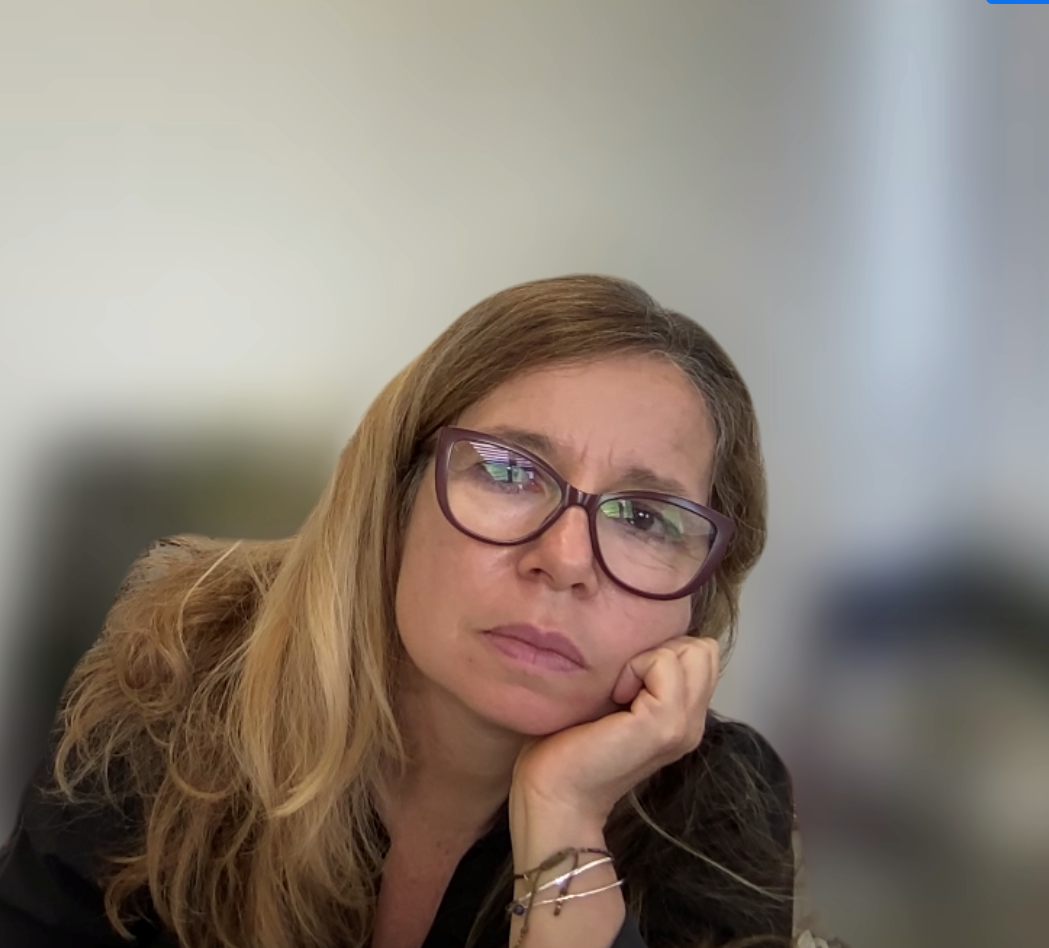
Title: Logarithmic Sobolev inequalities on Euclidean and curved structures: sharpness, rigidity and applications
Abstract: By using optimal mass transportation (OMT), we provide a new, direct proof to the sharp Lp-logarithmic Sobolev inequality (LSI) in R^n. The perk of this approach is that it allows to characterize the extremal functions even in weighted LSI on open convex cones of the Euclidean space R^n for every p,n>1. This approach can be used to provide sharp LSI on Riemannian manifolds with non-negative Ricci curvature, answering an open question of Cordero-Erausquin, Nazaret and Villani (Adv. Math., 2004), where the optimal constant contains the so-called asymptotic volume ratio of the manifold. Finally, a suitable modification of the OMT allows to obtain sharp LSI on Euclidean submanifolds, where the mean curvature plays a crucial role. Applications are provided to sharp hypercontractivity estimates of Hopf-Lax semigroups. The talk is based on joint works with Zoltan M. Balogh.
Alexandru Kristaly is a Full Professor at Babes-Bolyai University, Cluj, Romania and at buda University, Budapest, Hungary. He is working in the interface of Calculus of Variations and Geometric Analysis (including elliptic PDEs, Riemann-Finsler and Sub-Riemannian geometry, Geometric and Functional inequalities, Optimization on Riemannian manifold). He investigates various nonlinear phenomena arising from mathematical physics and (synthetic or differential) geometry where the curvature of the ambient space has a decisive role.
He received PhD degrees from the Babes-Bolyai University (2003), University of Debrecen (2005) and Central European University (2010). Habilitated both at the Babes-Bolyai University (2013) and buda University (2015), he also received the title of Doctor in Science from the Hungarian Academy of Sciences (2019). He supervised 7 PhD Students.
He was invited to various top research institutes, as IHES, City University of Hong Kong, University of Oxford, University of Bern, Kyoto University, University of Toronto, etc.
Prof Annalisa Buffa
EPFL, Switzerland
[Invited Speaker]
Title: To be announced
Abstract: Details will be announced soon.
Annalisa Buffa is a professor of mathematics at the Ecole Polytechnique Federale de Lausanne (EPFL) since 2016. From 2022 to 2024, she served as Associate Vice President for Postgraduate Education, and since 2025 she has been Associate Vice President for Research.
She was the Research Director and Director of the Istituto di Matematica Applicata e Tecnologie Informatiche of the Italian National Research Council (CNR). Annalisa Buffa is a corresponding member of the Accademia dei Lincei, an associe etranger of the French Academy of Sciences, a member of Academia Europaea, and a member of the European Academy of Sciences.
She is a leading expert in the numerical analysis of partial differential equations (PDEs). Her interests span geometric design, computational mechanics, and computational electromagnetics, as well as approximation theory and functional analysis for PDEs. She received an ERC Starting Grant in 2008 and an ERC Advanced Grant in 2016. She is a recipient of the Collatz Prize from the ICIAM (2015) and was the AWM-SIAM Sonya Kovalevskaya Lecturer at ICIAM 2023.
She has been a plenary speaker at several venues, including the European Congress of Mathematicians in 2024, the ECCOMAS conference in 2022, the centennial of the IMU in 2021, the AIMS Conference on Dynamical Systems, Differential Equations and Applications in 2018, the International Congress of Mathematicians (Section 15, 2014), the ICIAM in 2015, the GAMM conference, and the FoCM conference in 2014. She will be a plenary speaker at the International Congress of Mathematicians, in 2026. Annalisa Buffa is a highly cited researcher, according to ISI (2019).
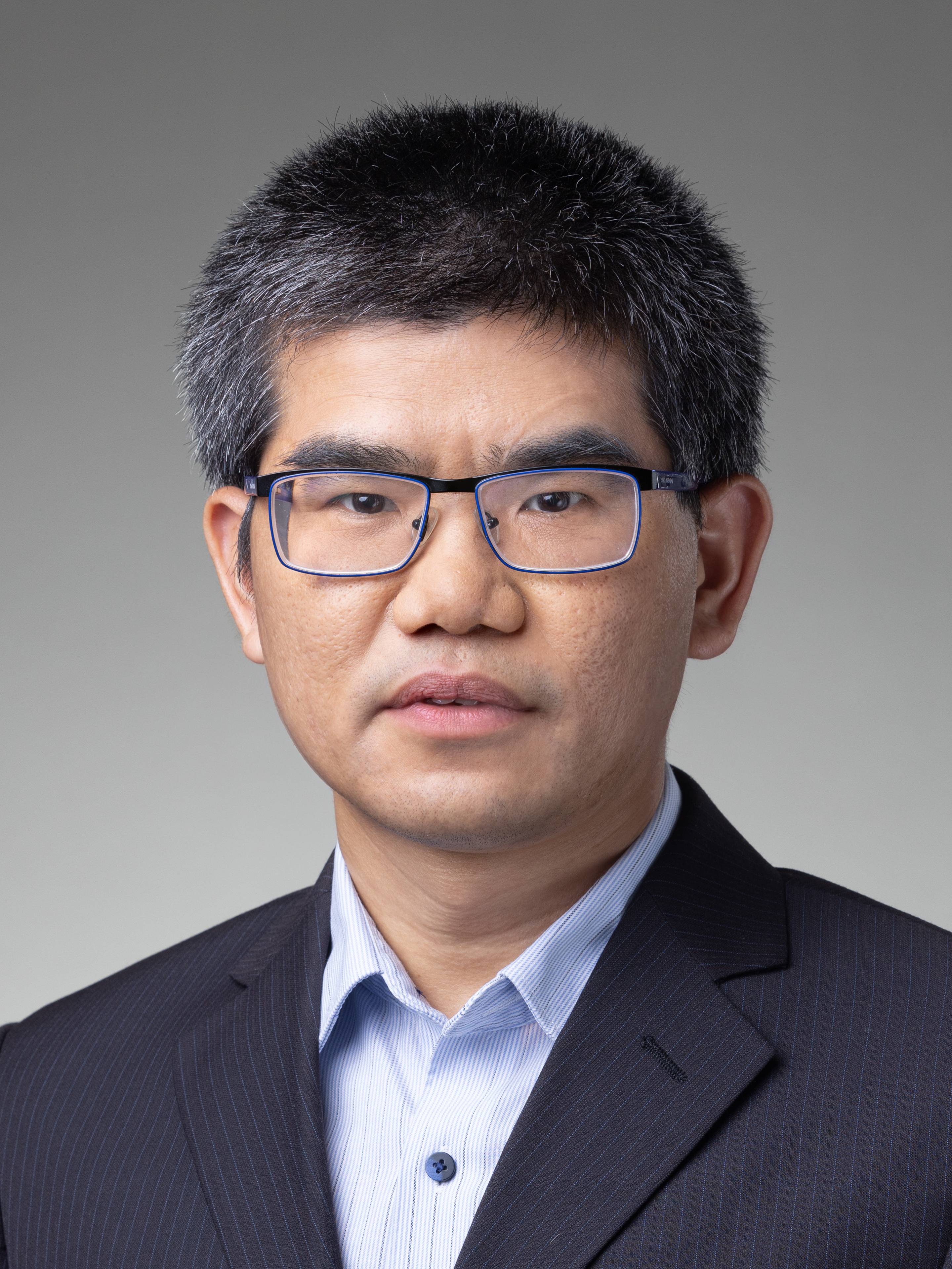
Title:Analysis Aware Defeaturing
Authors:Annalisa Buffa & Philipp Weder
Abstract:Geometry simplification, or defeaturing, is a key step in industrial simulations. It not only facilitates the meshing process but also significantly reduces the computational cost of subsequent simulations by lowering the number of degrees of freedom.
Conventional defeaturing methods typically rely on purely geometric criteria, disregarding the underlying physics and accuracy requirements. In contrast, analysis-aware defeaturing addresses this limitation through a posteriori error estimation, which combines the output of the defeatured simulation with the information from the exact geometry to guide the simplification process.
In this work, we discuss the construction of such estimators and demonstrate their effectiveness across various relevant scenarios.
Annalisa Buffa is a professor of mathematics at the cole Polytechnique Federale de Lausanne (EPFL) since 2016. From 2022 to 2024, she served as Associate Vice President for Postgraduate Education, and since 2025 she has been Associate Vice President for Research.
She was the Research Director and Director of the Istituto di Matematica Applicata e Tecnologie Informatiche of the Italian National Research Council (CNR). Annalisa Buffa is a corresponding member of the Accademia dei Lincei, an associe etranger of the French Academy of Sciences, a member of Academia Europaea, and a member of the European Academy of Sciences.
She is a leading expert in the numerical analysis of partial differential equations (PDEs). Her interests span geometric design, computational mechanics, and computational electromagnetics, as well as approximation theory and functional analysis for PDEs. She received an ERC Starting Grant in 2008 and an ERC Advanced Grant in 2016. She is a recipient of the Collatz Prize from the ICIAM (2015) and was the AWM-SIAM Sonya Kovalevskaya Lecturer at ICIAM 2023.
She has been a plenary speaker at several venues, including the European Congress of Mathematicians in 2024, the ECCOMAS conference in 2022, the centennial of the IMU in 2021, the AIMS Conference on Dynamical Systems, Differential Equations and Applications in 2018, the International Congress of Mathematicians (Section 15, 2014), the ICIAM in 2015, the GAMM conference, and the FoCM conference in 2014. She will be a plenary speaker at the International Congress of Mathematicians, in 2026. Annalisa Buffa is a highly cited researcher, according to ISI (2019).
Prof Bangti Jin
The Chinese University of Hong Kong
[Invited Speaker]
Title: Stochastic gradient descent for solving inverse problems
Abstract: Iterative methods represent a very important class of solution techniques for solving applied inverse problems. Due to their excellent scalability, stochastic iterative methods, including stochastic gradient descent and its variants, have received much attention in the last years for solving large-scale inverse problems and have demonstrated impressive empirical performance in many applied inverse problems. However, the mathematical theory of these stochastic methods for solving inverse problems is still in its infancy. In this talk, we survey some recent works on stochastic iterative methods for solving linear and nonlinear inverse problems in Hilbert and Banach spaces in the lens of classical regularization theory.
Bangti Jin received a PhD in Mathematics from the Chinese University of Hong Kong, Hong Kong in 2008. Previously, he was Lecturer and Reader, and Professor at Department of Computer Science, University College London (2014-2022), an assistant professor of Mathematics at the University of California, Riverside (2013-2014), a visiting assistant professor at Texas A&M University (2010-2013), an Alexandre von Humboldt Postdoctoral Researcher at University of Bremen (2009-2010). Currently he is Professor of Mathematics, Global STEM Scholar of Hong Kong SAR at the Chinese University of Hong Kong.
His research interests include inverse problems, numerical analysis and machine learning. Currently he serves on the editorial board of eight international journals in applied and computational mathematics, and was selected for a ISI highly cited researcher in mathematics by Clarivate Analytics in 2022.
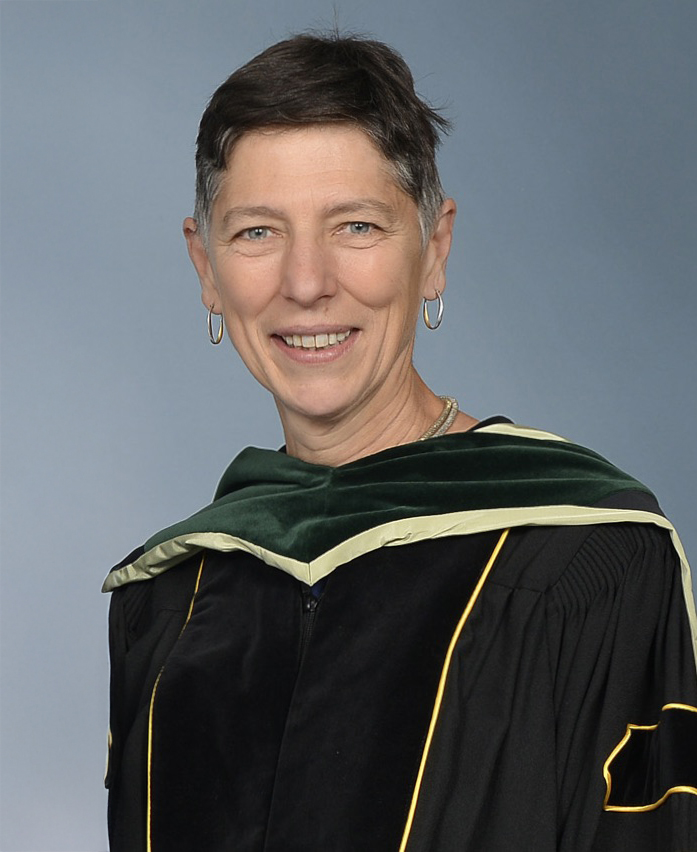
Title: Stochastic gradient descent for solving inverse problems
Abstract: Iterative methods represent a very important class of solution techniques for solving applied inverse problems. Due to their excellent scalability, stochastic iterative methods, including stochastic gradient descent and its variants, have received much attention in the last years for solving large-scale inverse problems and have demonstrated impressive empirical performance in many applied inverse problems. However, the mathematical theory of these stochastic methods for solving inverse problems is still in its infancy. In this talk, we survey some recent works on stochastic iterative methods for solving linear and nonlinear inverse problems in Hilbert and Banach spaces in the lens of classical regularization theory.
Bangti Jin received a PhD in Mathematics from the Chinese University of Hong Kong, Hong Kong in 2008. Previously, he was Lecturer and Reader, and Professor at Department of Computer Science, University College London (2014-2022), an assistant professor of Mathematics at the University of California, Riverside (2013-2014), a visiting assistant professor at Texas A&M University (2010-2013), an Alexandre von Humboldt Postdoctoral Researcher at University of Bremen (2009-2010). Currently he is Professor of Mathematics, Global STEM Scholar of Hong Kong SAR at the Chinese University of Hong Kong.
His research interests include inverse problems, numerical analysis and machine learning. Currently he serves on the editorial board of eight international journals in applied and computational mathematics, and was selected for a ISI highly cited researcher in mathematics by Clarivate Analytics in 2022.
Prof Beatrice Pelloni
Heriot-Watt University and The Maxwell Institute for Mathematical Sciences, Scotland
[Invited Speaker]
Title: Optimal transport methods in the study of atmospheric flows
Abstract: The formulation in terms of optimal transport of classical systems of fluid dynamics, such as the semigeostrophic system equations, was a spectacular advance due to Benamou and Brenier some 25 years ago. The broader applicability of such formulations, in continuous and discrete settings, is underpinning powerful advances in the mathematical and numerical modelling of fluid dynamics more generally. I will present some example, highlighting the novelty of the approach both in terms of the analysis and in terms of numerical modelling.
Professor Beatrice Pelloni is well known for her study of boundary value problems for linear and nonlinear PDEs of interest in mathematical physics, including water wave and atmospheric flow models.
She was the Olga Taussky-Todd prize lecturer at the International Congress of Applied and Industrial Mathematics in 2011, and the LMS Mary Cartwright Lecturer for 2019. She was elected Fellow of the IMA in 2012, and Fellow of the Royal Society of Edinburgh in 2020.
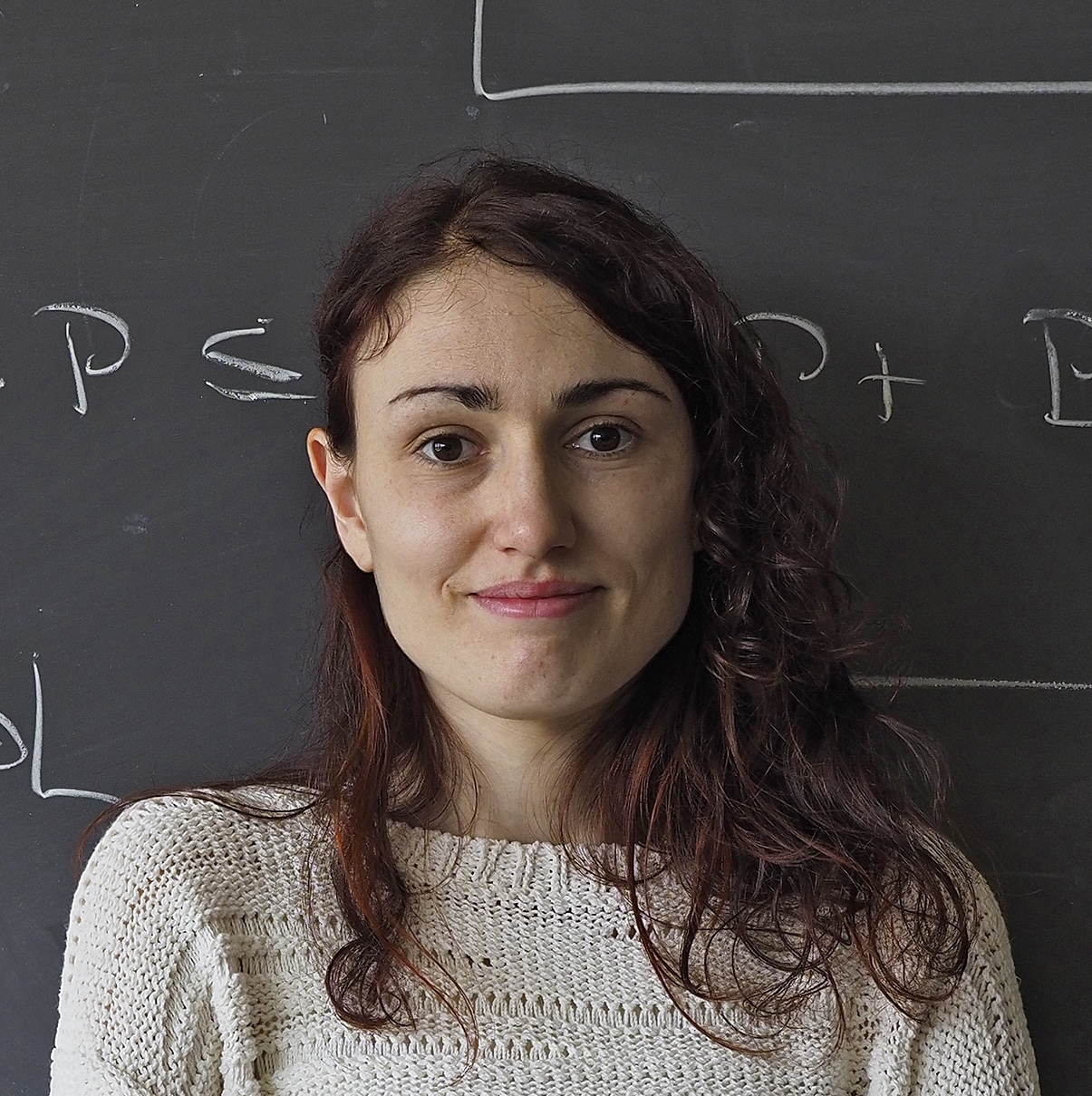
Title: Optimal transport methods in the study of atmospheric flows
Abstract: The formulation in terms of optimal transport of classical systems of fluid dynamics, such as the semigeostrophic system equations, was a spectacular advance due to Benamou and Brenier some 25 years ago. The broader applicability of such formulations, in continuous and discrete settings, is underpinning powerful advances in the mathematical and numerical modelling of fluid dynamics more generally. I will present some example, highlighting the novelty of the approach both in terms of the analysis and in terms of numerical modelling.
112Professor Beatrice Pelloni is well known for her study of boundary value problems for linear and nonlinear PDEs of interest in mathematical physics, including water wave and atmospheric flow models.
She was the Olga Taussky-Todd prize lecturer at the International Congress of Applied and Industrial Mathematics in 2011, and the LMS Mary Cartwright Lecturer for 2019. She was elected Fellow of the IMA in 2012, and Fellow of the Royal Society of Edinburgh in 2020.
Prof Cristiana De Filippis
University of Parma, Italy
[Invited Speaker]
Title: Regularity in nonuniformly elliptic problems
Abstract: I will review recent advances on the regularity of solutions to nonuniformly elliptic problems, with emphasis on the achievement of Schauder theory within the sharp nonuniformity range.
Cristiana De Filippis, University of Parma, was born in 1992. Her work focuses on the qualitative and regularity properties of solutions to nonlinear elliptic and parabolic partial differential equations (PDEs), particularly those arising from variational problems. Her contributions to the field have earned her several prestigious accolades, including election to the inaugural cohort of the European Mathematical Society Young Academy in 2023 and a European Mathematical Society Prize in 2024. In 2023 Forbes recognized her as one of the 100 most successful Italian women.
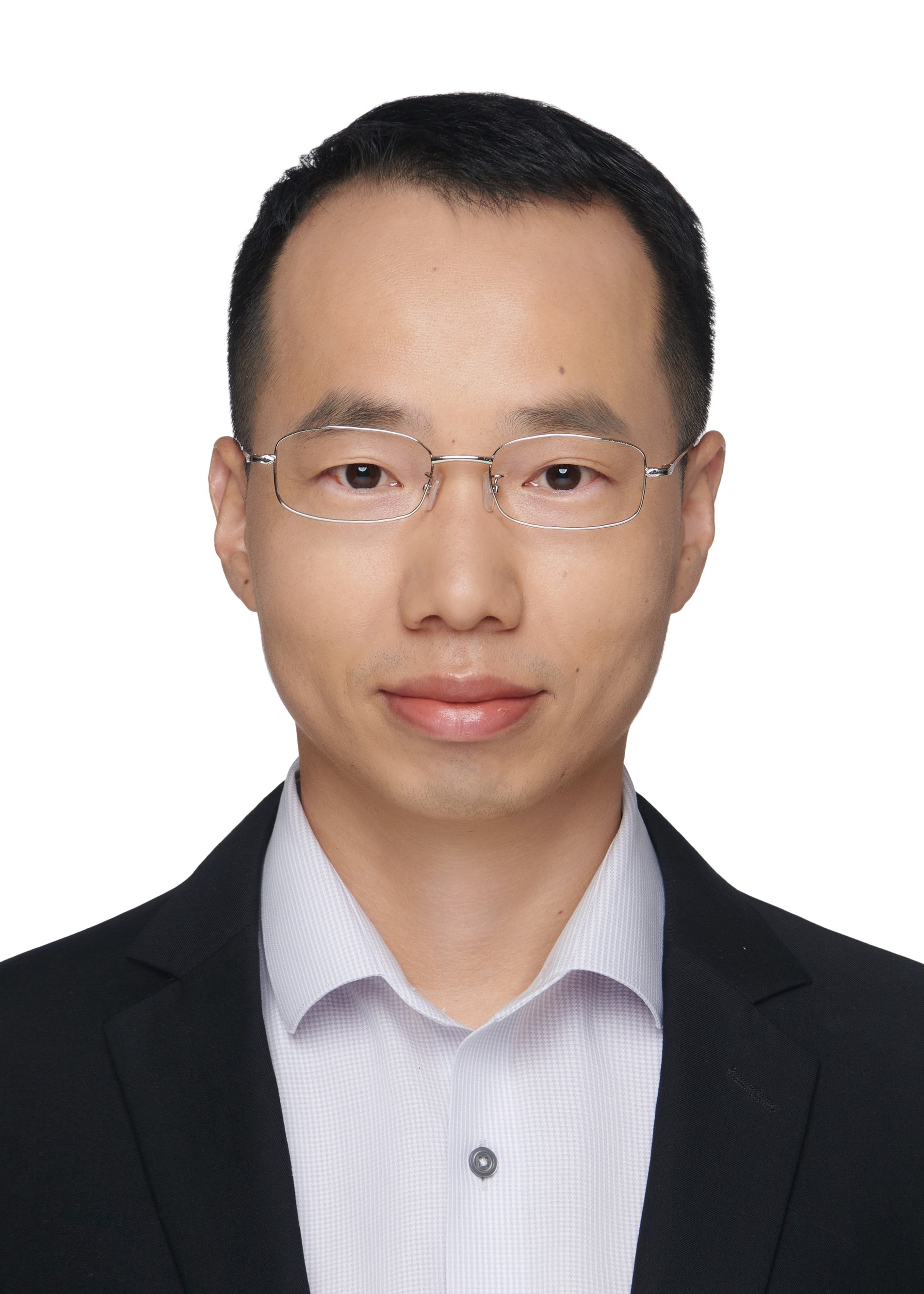
Title: Regularity in nonuniformly elliptic problems
Abstract: I will review recent advances on the regularity of solutions to nonuniformly elliptic problems, with emphasis on the achievement of Schauder theory within the sharp nonuniformity range.
Cristiana De Filippis, University of Parma, was born in 1992. Her work focuses on the qualitative and regularity properties of solutions to nonlinear elliptic and parabolic partial differential equations (PDEs), particularly those arising from variational problems. Her contributions to the field have earned her several prestigious accolades, including election to the inaugural cohort of the European Mathematical Society Young Academy in 2023 and a European Mathematical Society Prize in 2024. In 2023 Forbes recognized her as one of the 100 most successful Italian women.
Prof Hai Zhang
The Hong Kong University of Science and Technology
[Invited Speaker]
Title: Mathematical theory of interface/edge spectra in topological photonics
Abstract: The discovery of topological insulators in condensed matter physics has opened new avenues for generating interface and edge modes in photonic and phononic media. These modes, confined near the interface between two distinct structures or along the boundary of a single structure, offer robust ways to guide and control light. Their origin lies in the symmetries and/or nontrivial topology of the underlying wave operators. In this talk, we report on recent advances toward rigorously establishing the existence of interface and edge spectra in a variety of topological photonic and phononic structures.
Prof. Hai Zhang obtained his PhD degree in mathematics from Michigan State University in 2013. He then worked two years in Ecole Normale Superieure in Paris as a postdoc. He joined HKUST as an Assistant Professor in 2015 and became a tenured associated professor of Mathematics in 2021. Prof. Zhang's research interests include wave propagation and scattering in complex media, inverse problems, and imaging. His recent work focuses on the mathematical foundations of topological materials, as well as the theoretical limits of computational resolution in imaging, inverse problems, and machine learning. He has published more than 40 high-impact papers in journals including JAMS, CMP, ARMA, ACHA, and SIAM-series Journals. Prof. Zhang is on the editorial board of Journals including Mathematical Methods in the Applied Sciences, Inverse Problems and Imaging. He is a recipient of the 2025 Hong Kong Mathematical Society Young Scholar Award, and the 2018 JiongWei Young Researcher Award.
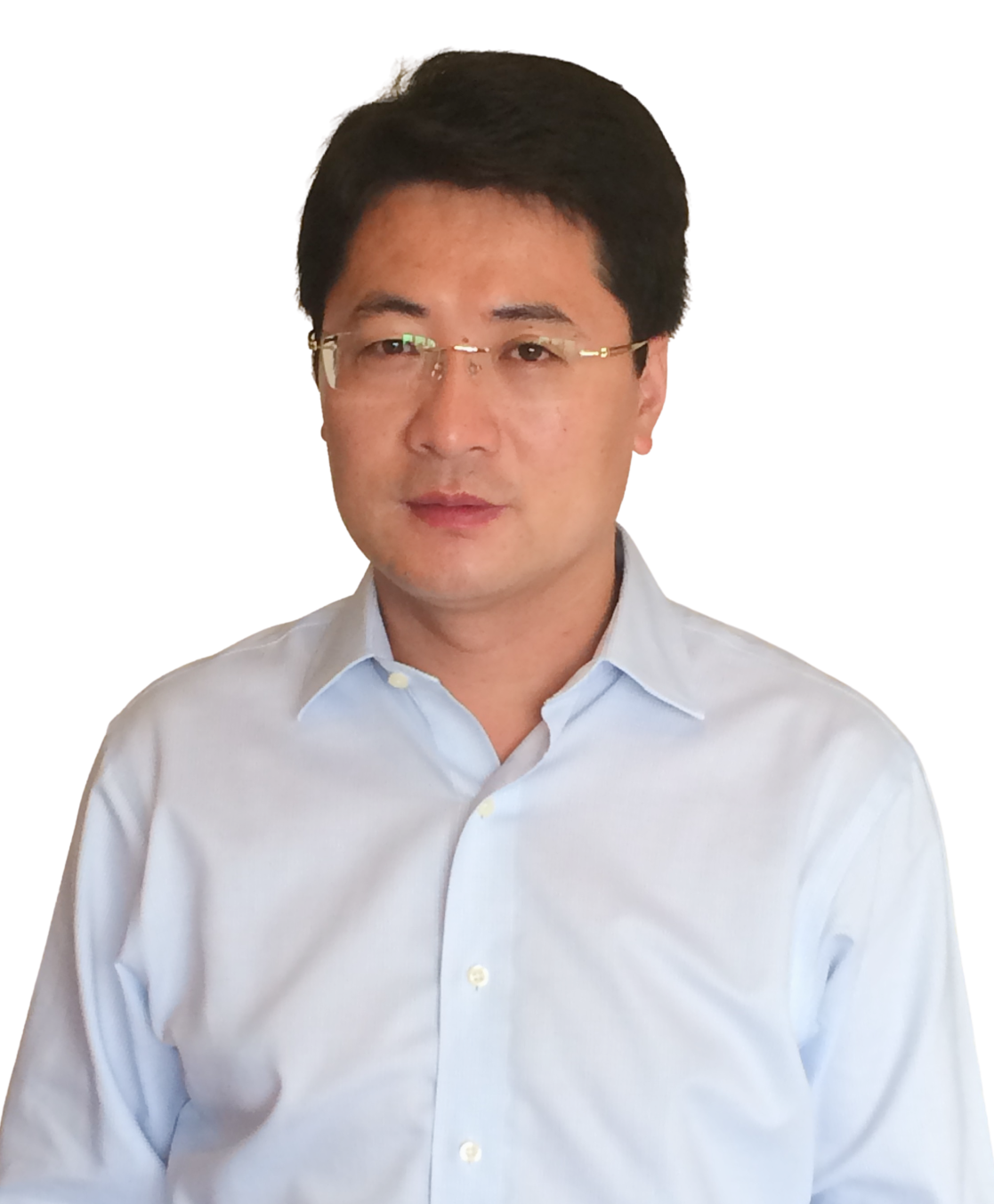
Title: Mathematical theory of interface/edge spectra in topological photonics
Abstract: The discovery of topological insulators in condensed matter physics has opened new avenues for generating interface and edge modes in photonic and phononic media. These modes, confined near the interface between two distinct structures or along the boundary of a single structure, offer robust ways to guide and control light. Their origin lies in the symmetries and/or nontrivial topology of the underlying wave operators. In this talk, we report on recent advances toward rigorously establishing the existence of interface and edge spectra in a variety of topological photonic and phononic structures.
Prof. Hai Zhang obtained his PhD degree in mathematics from Michigan State University in 2013. He then worked two years in Ecole Normale Superieure in Paris as a postdoc. He joined HKUST as an Assistant Professor in 2015 and became a tenured associated professor of Mathematics in 2021. Prof. Zhang's research interests include wave propagation and scattering in complex media, inverse problems, and imaging. His recent work focuses on the mathematical foundations of topological materials, as well as the theoretical limits of computational resolution in imaging, inverse problems, and machine learning. He has published more than 40 high-impact papers in journals including JAMS, CMP, ARMA, ACHA, and SIAM-series Journals. Prof. Zhang is on the editorial board of Journals including Mathematical Methods in the Applied Sciences, Inverse Problems and Imaging. He is a recipient of the 2025 Hong Kong Mathematical Society Young Scholar Award, and the 2018 JiongWei Young Researcher Award.
Prof Hongyu Liu
City University of Hong Kong
[Invited Speaker]
Title: To be announced
Abstract: Details will be announced soon.
Hongyu Liu is a Chair Professor of Applied Mathematics at City University of Hong Kong. His research focuses on the analysis, computation and applications of inverse problems and imaging, wave propagation, partial differential equations, mathematical materials science, scattering theory and spectral theory, game theory and mathematical biology.
Title: Pattern formations of coupled PDEs with transparent boundary conditions and applications
Abstract: In this talk, I will discuss our study on a class of coupled PDEs with transparent boundary conditions that arises in a variety of cutting-edge applications including inverse boundary problems, spectral geometry of invisibility, and super-resolution imaging. I shall report several peculiar local and global pattern formations of these PDEs. Several novel applications will also be discussed.
Details will be announced soon.
Prof Joachim Rosenthal
University of Zurich, Switzerland
[Invited Speaker]
Title: The Standardization Process to Post-Quantum Cryptography
Abstract: Public key cryptography is central to modern cryptography. With the realization that a quantum computer would render many widely-used public key systems obsolete, it became essential to design systems secure against quantum adversaries. This lecture overviews the ongoing standardization process in post-quantum cryptography and explains the underlying mathematical problems.
Joachim Rosenthal earned his Diploma in mathematics from the University of Basel, Switzerland, in 1986, followed by a Ph.D. in mathematics from Arizona State University in 1990. From 1990 to 2004, he was a distinguished member of the faculty at the University of Notre Dame, USA, where he held the Endowed Chair of Applied Mathematics and served as a Concurrent Professor of Electrical Engineering. In 2004, he was appointed Professor of Applied Mathematics at the University of Zurich.
His current research interests are in coding theory and cryptography. His prolific career includes close to 200 co-authored publications and the supervision of 30 doctoral students. Notably, over half of his former Ph.D. students have gone on to hold professorships.
Professor Rosenthal is recognized for his contributions as a Fellow of the IEEE and a Fellow of the Society for Industrial and Applied Mathematics (SIAM). His achievements have also been honored with honorary degrees from Universidad del Norte, Colombia, and the University of Alicante, Spain. He presently holds the position of President of the Swiss Mathematical Society.
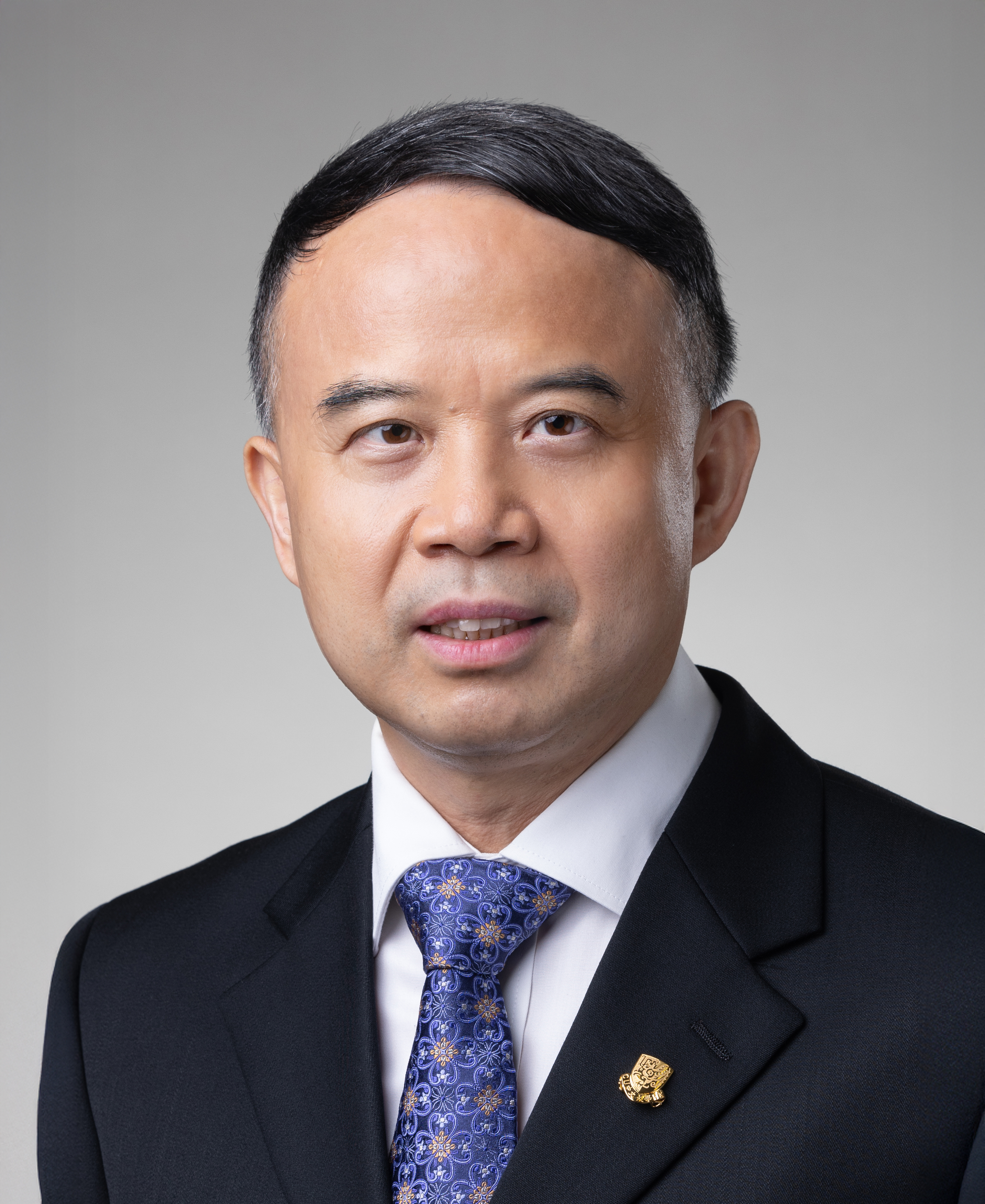
Title: The Standardization Process to Post-Quantum Cryptography
Abstract: Public key cryptography has been at the center of modern cryptography. It is not only used for the exchange of secret keys but also for the authentication of entities on the Internet, for digital signatures and for the construction of digital currencies. Until a few years ago most public key systems were based on the hardness of factoring integers or on the hardness of the discrete logarithm problem in an elliptic curve. With the realization that a quantum computer would make many practically used public key cryptographic systems obsolete it became an important research topic to design public key systems which are expected to be secure even if a powerful quantum computer would exist. This new area of research is called post-quantum cryptography and there has been in the last couple of years a lot of efforts to come up with new standards to be used in everyday applications. The lecture will overview the currently ongoing standardization process and will explain the underlying mathematical problems.
Joachim Rosenthal earned his Diploma in Mathematics from the University of Basel, Switzerland, in 1986, followed by a Ph.D. in mathematics from Arizona State University in 1990. From 1990 to 2004, he was a distinguished member of the faculty at the University of Notre Dame, USA, where he held the Endowed Chair of Applied Mathematics and served as a Concurrent Professor of Electrical Engineering. In 2004, he was appointed Professor of Applied Mathematics at the University of Zurich.
His current research interests are in coding theory and cryptography. His prolific career includes close to 200 co-authored publications and the supervision of 30 doctoral students. Notably, over half of his former Ph.D. students have gone on to hold professorships. Professor Rosenthal is recognized for his contributions as a Fellow of the IEEE and a Fellow of SIAM. His achievements have also been honoured with honorary degrees from Universidad del Norte, Colombia, and the University of Alicante, Spain. He presently holds the position of President of the Swiss Mathematical Society.
Prof Jun Zou
The Chinese University of Hong Kong
[Invited Speaker]
Title: Two-level hybrid Schwarz preconditioners for the Helmholtz equation with high wave number
Abstract: We discuss two novel two-level hybrid Schwarz preconditioners for solving the Helmholtz equation with high wave number in 2D and 3D. Each preconditioner consists of a global coarse solver based on the localized orthogonal decomposition (LOD) technique and local solvers on overlapping subdomains. Both preconditioners are shown to be optimal under reasonable conditions, providing uniform spectral bounds with respect to mesh sizes, subdomain size, and wave numbers. Numerical experiments confirm their optimality and efficiency.
Jun Zou is currently Choh-Ming Li Chair Professor of Mathematics of The Chinese University of Hong Kong, and Head of Department of Mathematics.
Before taking up his position at The Chinese University of Hong Kong in 1995, he had worked two years (93-95) in University of California at Los Angeles as a post-doctoral fellow and a CAM Assistant Professor, worked two and a half years (91-93) in Technical University of Munich as a Visiting Assistant Professor and an Alexander von Humboldt Research Fellow (Germany). He also worked two years (89-91) in Chinese Academy of Sciences (Beijing) as an Assistant Professor, right after he received his PhD degree there.
Jun Zou's research interests include numerical methods and analyses of direct and inverse problems of partial differential equations. He is currently president of Hong Kong Society for Industrial and Applied Mathematics, and vice president of Hong Kong Mathematical Society. He serves currently as the associate editor of 12 international mathematics journals, including the top applied mathematics and numerical analysis journals: SIAM Journal on Numerical Analysis, SIAM Journal on Scientific Computing, Journal of Scientific Computing, IMA Journal of Numerical Analysis and ESAIM: Mathematical Modelling and Numerical Analysis.
Jun Zou was elected a SIAM Fellow in 2019 and an AMS Fellow in 2022.
Title: Two-level hybrid Schwarz preconditioners for the Helmholtz equation with high wave number
Abstract: In this talk, we discuss and analyze two novel two-level hybrid Schwarz preconditioners for solving the Helmholtz equation with high wave number in both two and three dimensions. Both preconditioners are defined over a set of overlapping subdomains, with each preconditioner formed by a global coarse solver and one local solver on each subdomain. The global coarse solver is based on the localized orthogonal decomposition (LOD) technique, which was proposed originally for the discretization schemes for elliptic multiscale problems with heterogeneous and highly oscillating coefficients and Helmholtz problems with high wave number to eliminate the pollution effect. The local subproblems are Helmholtz problems in subdomains with homogeneous boundary conditions (for the first preconditioner) or impedance boundary conditions (for the second preconditioner). Both preconditioners are shown to be optimal under some reasonable conditions, that is, a uniform upper bound of the preconditioned operator norm and a uniform lower bound of the field of values are established in terms of all the key parameters, such as the fine mesh size, the coarse mesh size, the subdomain size and the wave numbers. This is the first time to show the rigorous optimality of a two-level Schwarz-type preconditioner with respect to all the key parameters and that the LOD solver can be a very effective coarse solver when it is used appropriately in the Schwarz method with multiple overlapping subdomains for the Helmholtz equation with high wave number. Numerical experiments are presented to confirm the optimality and efficiency of the two proposed preconditioners. This is a joint work with Peipei Lu (Soochow University), Xuejun Xu (Tongji University) and Bowen Zheng (Academy of Mathematics and Systems Science, Chinese Academy of Sciences). The work of Jun Zou was substantially supported by Hong Kong RGC General Research Fund (projects 14306623 and 14308322) and NSFC/Hong Kong RGC Joint Research Scheme (project N_CUHK465/22).
Jun Zou is currently Choh-Ming Li Chair Professor of Mathematics of The Chinese University of Hong Kong, and Head of Department of Mathematics.
Before taking up his position at The Chinese University of Hong Kong in 1995, he had worked at UCLA as a post-doctoral fellow and CAM Assistant Professor (1993 1995), at Technical University of Munich as a Visiting Assistant Professor and Alexander von Humboldt Research Fellow (1991 1993), and at the Chinese Academy of Sciences as an Assistant Professor (1989 1991).
His research interests include numerical methods and analyses of direct and inverse problems of partial differential equations. He is president of Hong Kong Society for Industrial and Applied Mathematics, and vice president of Hong Kong Mathematical Society. He serves as associate editor of leading journals including SIAM Journal on Numerical Analysis and SIAM Journal on Scientific Computing. He was elected a SIAM Fellow (2019) and an AMS Fellow (2022).

Prof Katharina Schratz
Sorbonne University, France
[Invited Speaker]
Details will be announced soon
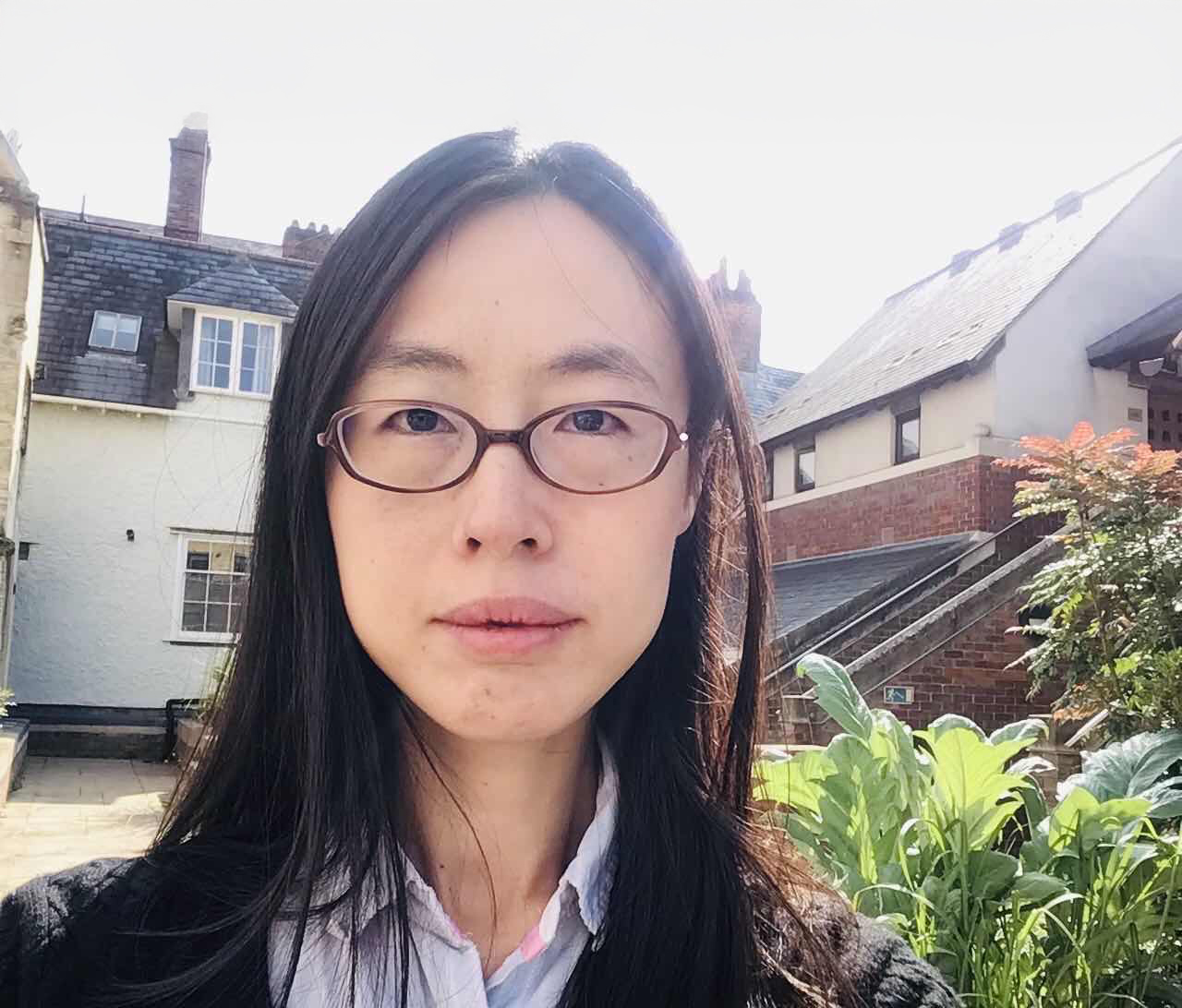
Katharina Schratz's research focuses on computational mathematics of non-linear partial differential equations, in particular, rough data, long time scales and structure preserving algorithms. She is professor at laboratory Jacques-Louis Lions at Sorbonne University in Paris and French director of the Chinese-French International Research Network (CNRS) together with Chinese director Professor Ping Zhang (CAS). She is member of five editorial boards and on board of directors of Foundations of Computational Mathematics Society.
Title: Resonances as a computational tool
Abstract: A large toolbox of numerical schemes for dispersive equations has been established, based on different discretization techniques such as discretizing the variation-of-constants formula (e.g., exponential integrators) or splitting the full equation into a series of simpler subproblems (e.g., splitting methods). In many situations these classical schemes allow a precise and efficient approximation. This, however, drastically changes whenever non-smooth phenomena enter the scene such as for problems at low regularity and high oscillations. Classical schemes fail to capture the oscillatory nature of the solution, which leads to severe instabilities and loss of convergence. In this talk I present a new class of resonance based schemes. The key idea in the construction of the new schemes is to tackle and deeply embed the underlying structure of resonances into the numerical discretization. As in the continuous case, these terms are central to structure preservation and offer the new schemes strong geometric properties at low regularity.
Prof Qian Wang
University of Oxford, UK
[Invited Speaker]
Title: On global dynamics of 3-D irrotational compressible fluids
Abstract: We consider global-in-time evolution of irrotational, isentropic, compressible Euler flow in 3-D for a broad class of H4 classical Cauchy data without assuming symmetry, prescribed on an annulus surrounded by a constant state in the exterior. We construct global exterior solutions with a general subclass forming rarefaction at null infinity, without smallness on transversal derivatives of the data, thus allowing arbitrarily large total energy.
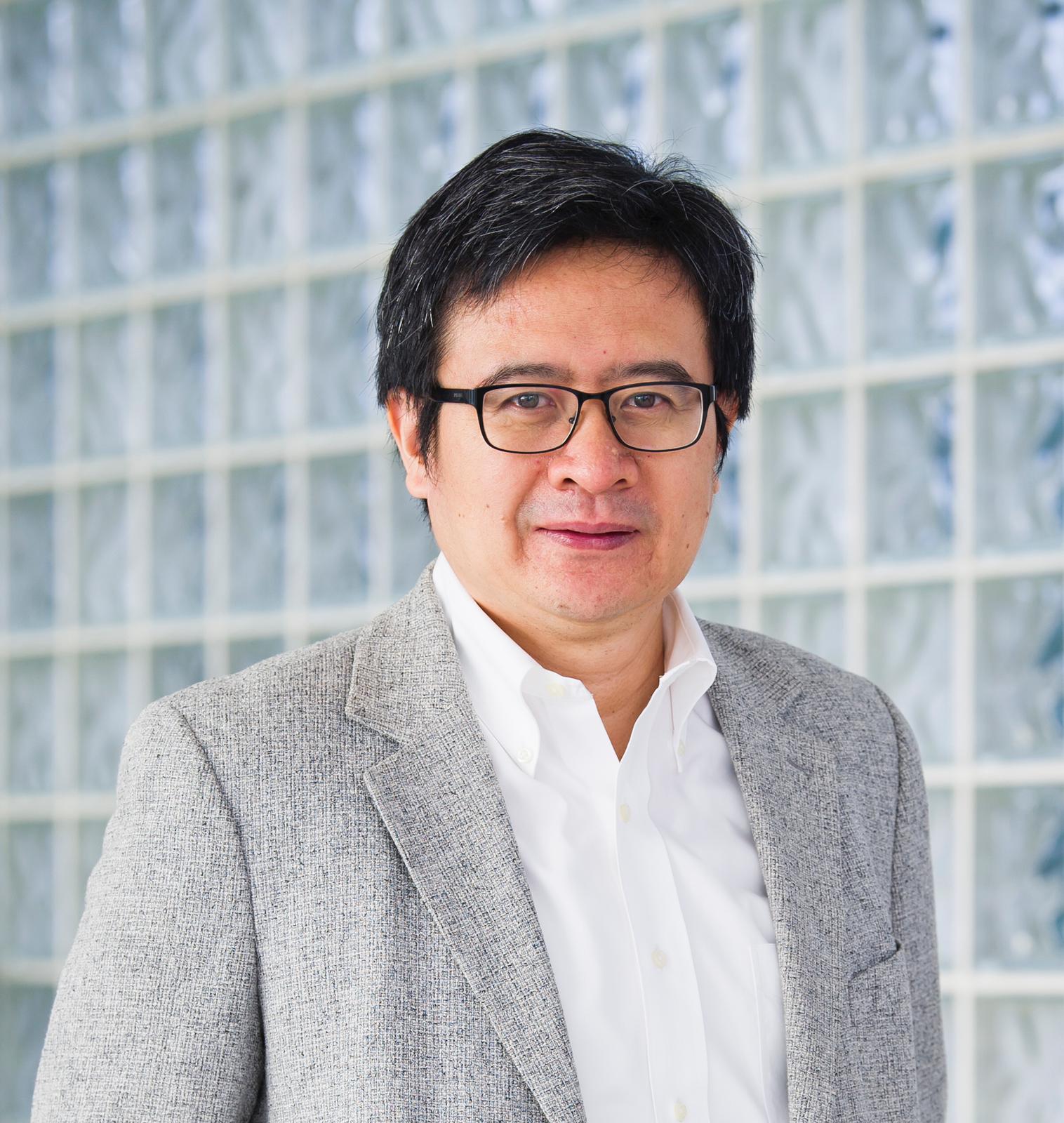
Professor Qian Wang is a mathematician specializing in hyperbolic partial differential equations and mathematical relativity. She is currently a Professor at the Oxford Centre for Nonlinear Partial Differential Equations in the Mathematical Institute, University of Oxford.
Wang received her Ph.D. in Mathematics from Princeton University in 2006, under the supervision of Professor Sergiu Klainerman, with a dissertation on the Causal Geometry of Einstein Vacuum Spacetimes. She obtained her B.Sc. in Mathematics from Nanjing University in 2001. Following her doctorate, she held postdoctoral positions at Stanford University, Stony Brook University (as a Simons Instructor), the Max Planck Institute for Gravitational Physics, and IHES, before joining Oxford in 2012. She was promoted to Professor of Mathematics in 2023.
Her research explores the global behavior of nonlinear wave equations, the Einstein equations in general relativity and dynamics of 3D compressible Euler equations, particularly focusing on issues of well-posedness, stability, and breakdown criterion. Her work has appeared in leading mathematical journals including Annals of Mathematics, Comm. Pure Appl. Math, Journal of Differential Geometry, Annals of PDE, and Communications in Mathematical Physics, etc.
Title: On global dynamics of 3-D irrotational compressible fluids
Abstract: We consider global-in-time evolution of irrotational, isentropic, compressible Euler flow in 3-D for a broad class of H4 classical Cauchy data without assuming symmetry, prescribed on an annulus surrounded by a constant state in the exterior. We construct global exterior solutions with a general subclass forming rarefaction at null infinity, without smallness on transversal derivatives of the data, thus allowing arbitrarily large total energy.
Prof Tong Yang
Wuhan University, China
[Invited Speaker]
Title: Some recent study on viscous fluid with strong boundary layers
Abstract: It is a classical problem in fluid dynamics about the stability and instability of different fluid patterns ... We will also discuss the high Reynolds number limit for the steady 2D compressible flow.
Tong Yang received his B.S. and M.S. degrees from Sun Yat-sen University in 1987 and 1990, and his Ph.D. at the University of California, Davis in 1993. He has been working on mathematical research of nonlinear partial differential equations, particularly kinetic equations and related macroscopic models, making contributions to hyperbolic conservation laws, boundary layer theory, Boltzmann equations, and related fields.
He has published over 200 papers in mathematical journals including Journal of the American Mathematical Society, Communications on Pure and Applied Mathematics, and Journal of the European Mathematical Society, accumulating over 5,000 citations. He is Deputy Editor of Acta Mathematica (since 2024) and serves on editorial boards of several international journals. Honors include Foreign Member of Academia Europaea (2022), Fellow of TWAS (2021), and Fellow of the Hong Kong Academy of Sciences (2021).
Title: Stability and instability of different fluid patterns
Abstract: It is a classical problem in fluid dynamics about the stability and instability of different fluid patterns ... We will also discuss the high Reynolds number limit for the steady 2D compressible flow.
Tong Yang received his B.S. and M.S. degrees from Sun Yat-sen University in 1987 and 1990, and his Ph.D. at the University of California, Davis in 1993. He has been working on mathematical research of nonlinear partial differential equations, particularly kinetic equations and related macroscopic models, making contributions to hyperbolic conservation laws, boundary layer theory, Boltzmann equations, and related fields.
He has published over 200 papers in mathematical journals including Journal of the American Mathematical Society, Communications on Pure and Applied Mathematics, and Journal of the European Mathematical Society, accumulating over 5,000 citations. He is Deputy Editor of Acta Mathematica (since 2024) and serves on editorial boards of several international journals. Honors include Foreign Member of Academia Europaea (2022), Fellow of TWAS (2021), and Fellow of the Hong Kong Academy of Sciences (2021).