


In this work we experimentally study many-body localization (MBL) with ultracold atoms in a weak one-dimensional quasiperiodic potential [namely, the generalized Aubry-Andre (GAA) model], which in the noninteracting limit exhibits an intermediate phase that is characterized by a coexistence of localized and extended single-particle orbitals. We measure the time evolution of an initial charge density wave after a quench and analyze the corresponding relaxation exponents. We find clear signatures of MBL when the corresponding noninteracting model is deep in the localized phase. We also critically compare and contrast our results with those from a tight-binding Aubry-Andre model, which does not exhibit a single-particle intermediate phase, in order to identify signatures of a potential many-body intermediate phase.
Read more at Physical Review Letters: https://doi.org/10.1103/PhysRevLett.122.170403
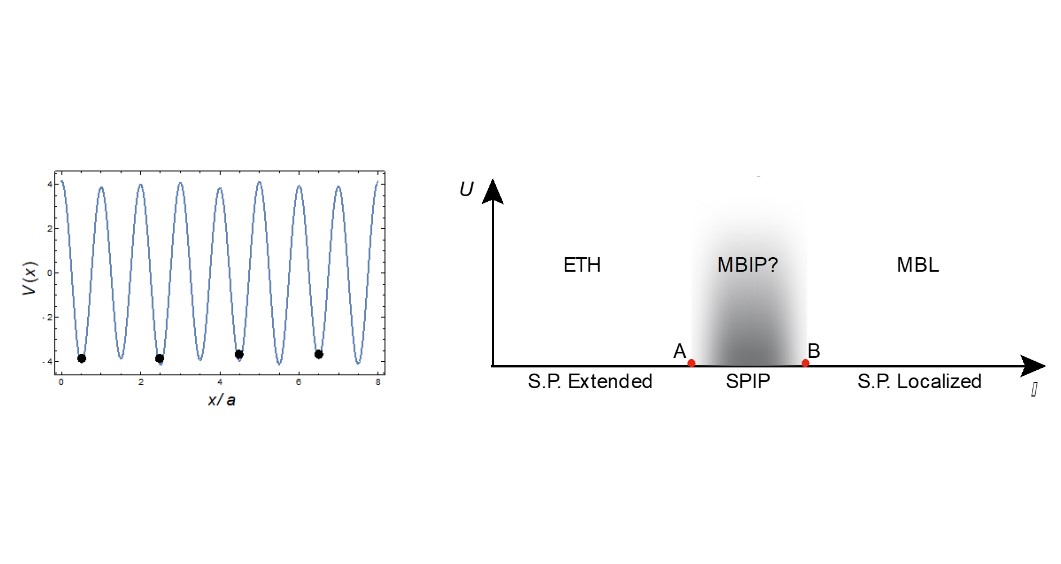
[Caption] Left: Cartoon picture of the initial charge density wave state in the experiment. The background curve represents the potential landscape and the black dots represent the initial positions of the atoms. Right: Heuristic phase diagram of the GAA model we study in this work. In the noninteracting limit the GAA model exhibits three phases [single-particle extended, single-particle intermediate (SPIP), and single-particle localized], with the phase boundary denoted by A and B. Here Δ is the strength of the detuning lattice, while U is the strength of the Hubbard on-site interactions. The situation with finite interactions is unknown in theory, although a full MBL phase is believed to exist in the regime where the corresponding noninteracting system is single-particle localized. Below the single-particle localization transition point A, interactions will lead to a thermal phase, where the eigenstate thermalization hypothesis (ETH) holds. The existence of a many-body intermediate phase (MBIP, marked in gray) is highly debated, which is one of the main motivations of our work.
03 May 2019