

RNA post-transcriptional modifications act by stabilizing the functional conformations of RNA. While their role in messenger RNA (mRNA) decoding is well established, it is less clear how transfer RNA (tRNA) modifications outside the anticodon contribute to tRNA stability and accurate protein synthesis. Absence of such modifications causes translation errors, including mRNA frameshifting. By integrating single-molecule fluorescence resonance energy transfer and cryogenic electron microscopy, we demonstrate that the N1-methylguanosine (m1G) modification at position 37 of Escherichia coli tRNAProL is necessary and sufficient for modulating the conformational energy of this tRNA on the ribosome so as to suppress +1 frameshifting otherwise induced by this tRNA. Six structures of E. coli ribosomal complexes carrying tRNAProL lacking m1G37 show this tRNA forms four and even five codon-anticodon base pairs as it moves into the +1 frame, allowing direct visualization of the long-standing hypothesis that a four base pair codon-anticodon can form during +1 frameshifting.
Read more at Nature Communications:
https://www.nature.com/articles/s41467-025-62342-4
Photo caption:
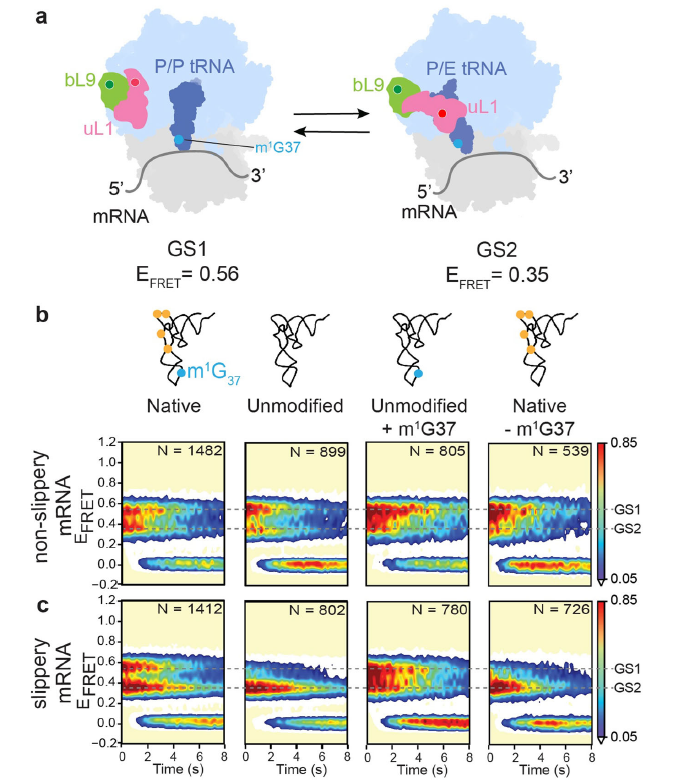
a Cartoon of the GS1⇄GS2 conformational equilibrium of a POST– complex containing Cy3- and Cy5-labeled ribosomal proteins bL9 and uL1, respectively, and carrying a P site-bound tRNAProL. Among other structural differences, GS1 features a P/P-configured tRNA and an open uL1 stalk, resulting in an EFRET value of 0.55. In contrast, GS2 features a P/E-configured tRNA and a closed uL1 stalk, resulting in an EFRET value of 0.35. b, c Surface contour plots are generated by superimposing numerous individual EFRET vs. time trajectories (Supplemental Fig. S1) recorded using smFRET experiments conducted on eight POST– complexes. Contours are colored from white (lowest population) to red (highest population), as indicated, and N at the rightmost top of each surface contour plot specifies the number of EFRET trajectories that were used to construct that plot. The eight POST– complexes carried either P-site native, unmodified, unmodified +m1G37, or native –m1G37 variants of tRNAProL, as specified by the tRNA cartoons along the top of the four columns of surface contour plots. In these cartoons, m1G37 is indicated in blue, and other tRNAProL modifications are depicted in yellow. In addition, these POST– complexes were formed using mRNAs that place either a proline CCC-G non-slippery codon or a proline CCC-C slippery codon at the P site, as specified along the left of the two rows of surface contour plots. A detailed description of how the smFRET data were analyzed, including how the % GS1, % GS2, Keq, kGS1→GS2, and kGS2→GS1 were calculated, can be found in the “Materials and Methods”.
11 Aug 2025