

Reaching the quantum limit for added noise in amplification processes is an important step toward many quantum technologies. Nearly quantum-limited traveling-wave parametric amplifiers with Josephson junction arrays have been developed and recently even become commercially available. However, the fundamental question of whether a single atom also can reach this quantum limit has not yet been answered in practice. Here, we investigate the amplification of a microwave probe signal by a superconducting artificial atom, a transmon, at the end of a semi-infinite transmission line, under a strong pump field. The end of the transmission line acts as a mirror for microwave fields. Due to the weak anharmonicity of the artificial atom, the strong pump field creates multi-photon excitations among the dressed states. Transitions between these dressed states, Rabi sidebands, give rise to either amplification or attenuation of the weak probe. We obtain a maximum power amplification of 1.402 ± 0.025, higher than in any previous experiment with a single artificial atom. We achieve near-quantum-limited added noise (0.157 ± 0.003 quanta; the quantum limit is 0.143 ± 0.006 quanta for this level of amplification), due to quantum coherence between Rabi sidebands, leading to constructive interference between emitted photons.
Read more at NPJ Quantum Information:
https://www.nature.com/articles/s41534-025-00993-3
Photo caption:
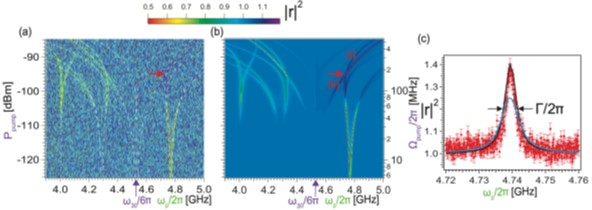
a Measured reflectance spectra ∣r∣2 of the weak probe field (Pp = −161 dBm) as a function of probe frequency ωp (x-axis) and pump power Ppump (y-axis). The pump frequency is ωpump = ω30/3 = 2π × 4.530 GHz. b Numerical simulation of the experiment. The left y-axis is the pump power; the right y-axis is the Rabi frequency Ωpump. We set M = 6 and use the relaxation rates Γn,n−1/2π = nΓ10/2π = 2.264n MHz, where n = 1, 2, …, 5. There are no free fitting parameters for the simulation. c A linecut taken at Ppump = −95 dBm from Supplementary Information Fig. 4, where the two amplified Rabi sidebands cross each other at ωp/2π ≈ 4.739 GHz (indicated by a red arrow in Fig. 2a, b), shows a maximum reflectance 1.402 ± 0.025. The black arrows indicate the width of the reflectance spectrum (Γ/2π ~ 4 MHz). The solid red dots are the experimental data with standard deviation, the solid black curve is the linecut of the numerical simulation from b, and the solid blue curve is the theoretical result without quantum coherence between the amplified Rabi sidebands26. The excess gain (black) is about twice that of the case without quantum interference (blue). The roughly 2% difference between data and theory from 4.72 to 4.73 GHz is most likely due to the gain drift of the HEMT amplifier (see Supplementary Information Fig. 1) measured with the background (reference) reflectance.
12 Mar 2025